
A Wild Revival
4/8/2026 | 50m 52sVideo has Closed Captions
Five ecosystems transformed by climate change give birth to new, sometimes even richer worlds.
In this episode, five ecosystems are reshaped by climate change. Ice fields and underwater forests vanish, replaced by new ecosystems. Humans and animals must adapt as nature transforms at unprecedented speed.
Problems playing video? | Closed Captioning Feedback
Problems playing video? | Closed Captioning Feedback
A Wild Revival
4/8/2026 | 50m 52sVideo has Closed Captions
In this episode, five ecosystems are reshaped by climate change. Ice fields and underwater forests vanish, replaced by new ecosystems. Humans and animals must adapt as nature transforms at unprecedented speed.
Problems playing video? | Closed Captioning Feedback
How to Watch Our New World
Our New World is available to stream on pbs.org and the free PBS App, available on iPhone, Apple TV, Android TV, Android smartphones, Amazon Fire TV, Amazon Fire Tablet, Roku, Samsung Smart TV, and Vizio.
Providing Support for PBS.org
Learn Moreabout PBS online sponsorshipNarration: This is the Mont Blanc Massif in the French Alps in 1870.
Using CGI, we can now visualize how it has evolved over the last 150 years.
The glacier has retreated, the ice has been replaced by prairie, and forests have climbed the slopes.
And this is a Canadian tundra landscape.
It, too, has evolved in the last century.
It gradually transformed into a boreal forest.
[Birds chirping and geese honking] ♪ Narration: It's not just the tundra or Mont Blanc.
Everywhere, rising temperatures are transforming the planet.
♪ Some regions are becoming inhospitable.
♪ ♪ Narration: Others are transformed into enchanting places.
♪ ♪ [Birds chirping] ♪ Narration: What world will we live in tomorrow?
♪ ♪ Narration: Men and women are at the heart of this upheaval.
♪ They tell us how their world is changing.
How nature is adapting to these new conditions.
So, this is a journey around our planet... to discover a new world.
Our new world.
♪ ♪ Narration: Around the globe, mountains are evolving.
In the Alps, shepherds are on the front line.
[Sheep bleating] [Cowbells clanking] [Sheep bleating] [Distant rumbling] [Dog barking] Narration: The permafrost, the frozen ground holding stone together, is melting... and the mountain is falling apart.
[Loud crash] [Calling commands] [Clapping] [Calling commands] Narration: But there's another danger for Louis, Clara, and their sheep.
Less spectacular, but just as worrying.
[Sheep bleating] [Sheep bleating] Narration: Drought forces Louis to climb to higher altitude earlier in the season.
And a new obstacle stands in his way: the forest.
To reach the highest alpine pastures, Louis must walk for two days, 1,000 sheep to move, without losing a single one.
[Sheep bleating] Narration: 60 years ago, where Louis walks today... there wasn't a single tree.
Everything changed because of milder winters.
♪ It started with the pioneers, birch and ash.
When there was enough soil, came the sycamore maples.
Then the most dominant... beech.
♪ This tall tree towers over all the others.
♪ ♪ ♪ ♪ ♪ Narration: The trees climbed towards the peaks.
Today, beech trees grow at altitudes of 6,000 feet.
♪ Above, it's spruce and larch territory.
♪ ♪ Narration: Forests are conquering the mountain.
♪ ♪ Narration: They gradually encroach on the meadows that feed marmots, mountain goats, and sheep.
♪ [Sheep bleating] [Clapping] Narration: For Louis, as for the prairie folk, the forest progressing is bad news.
But for others, it's a Godsend.
In the wake of the trees, all the woodland inhabitants have followed.
They have come up from the plains and valleys.
[Owl hooting] Narration: They benefit greatly from their new life in the mountains.
[Owl hooting] Narration: The coolness of altitude in summer... [Animals calling] Narration: Peaceful spaces with far fewer humans.
[Hooves galloping] [Wind rushing] Narration: These new forests have become safe havens for wild animals.
But they also offer cover for the sheep's fiercest predator.
[Sheep bleating] ♪ ♪ ♪ [Sheep bleating] ♪ [Dog barking] ♪ ♪ [Dog barking and sheep bleating] [Dog barking and sheep bleating] Narration: Mountains with more trees, drier and more dangerous... Such is Louis' new world.
[Calling commands] [Rolls tongue] [Calling commands] [Clara calling commands] [Clapping] [Calling commands] [Sheep bleating and Louis calling commands] [Louis and Clara calling commands] Narration: Louis eventually makes it through the forest without harm.
Thanks to his dogs, the wolves stayed at bay.
[Sheep bleating] ♪ ♪ [Sheep bleating] ♪ ♪ Woo!
[Calling commands] [Sheep bleating] [Cowbells clanking] [Sheep bleating] Narration: Today the landscape revealed by the receding ice is undergoing total transformation.
On this land, buried for thousands of years, many plants are trying their luck.
Rhododendrons, junipers, blueberries, small trees too, like creeping willows.
They take these virgin lands by storm, flourishing despite the cold, the wind, and the scorching sun.
♪ Where the ice withdraws, new worlds are born.
♪ [Speaking French] [Sheep bleating and dog barking] [Eagle chirping] Narration: To escape the heat, mountain dwellers move to higher ground in summer.
♪ ♪ ♪ Narration: Alpine ibex and mountain goats find high meadows that have not yet been taken over by the forest.
♪ ♪ Narration: On the other hand, it is tougher for some species.
[Marmots screeching] ♪ ♪ Narration: Marmots spend six months of the year sleeping.
When winter arrives, they rely on a thick layer of snow... ♪ A blanket that insulates them from the cold.
♪ This layer has diminished considerably over the last 50 years.
♪ [Wind rushing] Narration: When there's less snow, it's cold.
Terribly cold.
The adults survive, but not all the pups.
There are also the white species.
Their winter coats are supposed to camouflage them in the snow.
But now spring is coming before their pelts change.
These mountain hares find themselves exposed and in danger because of the shift in seasons.
♪ ♪ ♪ [Black grouse calling] Narration: Are these species doomed?
There's one solution left: to breed with their downhill neighbors, like the mountain hare and the brown hare.
It seems as if these two species have already begun flirting.
[Sheep bleating and Louis calling in distance] [Cowbells clanking] [Sheep bleating] ♪ Narration: Like the marmots, glaciers are one of the victims of global warming.
[Low rumbling] Narration: They will gradually be replaced by lakes, meadows, and forests.
♪ ♪ Narration: New havens for some of the fauna... But no more glaciers, no more everlasting snow, means less water in the rivers that depend on them.
♪ [Geese honking] Narration: In a few generations, forests could well cover the peaks of the Alps.
This green wave is affecting many mountain ranges throughout the world.
The Rockies, the Andes, the Himalayas.
It is slowly changing the face of the Earth.
In the oceans, a profound transformation of ecosystems is also underway.
In Japan, ocean warming is having a major impact.
Stretchers of seaweed are disappearing from the south of the archipelago.
They are becoming vulnerable to disease and to invaders.
♪ Voracious herbivores are moving in from the warm seas.
They feast on the seaweed.
♪ Sea urchins proliferate, and they wreak havoc.
♪ ♪ Narration: This phenomenon where underwater forests of seaweed disappear is called isoyake.
♪ In Japan, a thousand-year-old tradition is maintained by a community of women sea divers, the Ama.
They free dive for a highly prized shellfish, abalone, which can only live in forests of seaweed.
[Man singing in Japanese] Narration: This community is now on the front line against the isoyake seaweed loss.
[Singing in Japanese continues] [Singing in Japanese continues] [Man speaking in Japanese] ♪ ♪ ♪ Narration: Today, Masae travels to an area she knows well, where the seaweed forests have already disappeared.
♪ ♪ ♪ ♪ ♪ ♪ ♪ ♪ ♪ ♪ [Waves crashing] ♪ ♪ ♪ ♪ ♪ ♪ ♪ ♪ ♪ Narration: Masae and the Ama witness the disappearing of the seaweed, as it cannot adapt to the rapid temperature change.
♪ ♪ ♪ [Bird calling] Narration: In Europe, temperate forests are also weakened by repeated droughts and heat waves.
[Bird calling] [Birds chirping] ♪ ♪ Narration: An enemy takes advantage of this, burrowing under the bark to eat away from the inside.
♪ Bark beetles proliferate thanks to mild winters.
♪ They kill trees because they cut off the flow of their sap.
♪ ♪ Narration: How can forests adapt to these upheavals?
[Birds calling] Narration: Nature already has an answer.
[Squirrel chittering] [Birds chirping] Narration: Thanks to squirrels, this oak tree has moved a hundred feet.
Southern trees have begun their journey northwards.
Fast enough to keep pace with climate change?
Not sure.
But humans can speed up the tree's natural migration.
These acorns carry our hopes for the centuries to come.
They carry the experience of generations of Mediterranean oaks, perfectly adapted to heat and drought.
They come to help the forests of continental Europe.
These young shoots will enable them to adapt to new conditions.
♪ This helping hand is called assisted migration.
♪ ♪ ♪ ♪ ♪ Narration: Within a century, forests of large Mediterranean oaks could populate northern Europe.
[Bird calling] Narration: What about the oceans?
Could assisted migration also be effective underwater?
♪ ♪ ♪ ♪ ♪ ♪ ♪ Narration: The Ama work for the conservation of these underwater forests.
♪ They harvest healthy leaves and replant them where the seaweed has been eliminated.
♪ ♪ ♪ ♪ Narration: Masae's world is disappearing.
[Whistling] Narration: But a new world is already emerging.
A few miles from her village, another life-form is taking the place of the seaweed... ♪ ♪ Narration: Corals.
Their larvae, carried by warm currents, arrive from the south.
They gain ground every day.
♪ ♪ Narration: A whole new ecosystem is emerging.
♪ ♪ ♪ ♪ Narration: Tropical corals are moving in on former seaweed territory on the coasts of southern and central Japan.
♪ ♪ ♪ ♪ Narration: In the tropics, entire coral reefs are dying off due to overheated waters.
They face a high risk of extinction in the decades to come.
♪ ♪ Narration: Is there a glimpse of hope in their journey to more temperate seas?
Will those seas be their lifeline?
Like the corals, many of the planet's living species are on the move, looking for new places to live.
And they move six times faster in the oceans, as there are no roads, railroads, or urban areas to impede their journey.
In this immense race against global warming, not all species have the same aptitude for speed.
The fastest will migrate with ease.
The more sedentary ones, however, will experience major difficulties.
And back in Alaska... I'm witnessing how this race to adapt can give birth to an incredible transformation.
[Low rumbling] [Seagulls calling] Narration: After we left the glacier, we came across a young ecosystem only a few miles away.
The glacier retreated from this place 20 years ago.
The dripping glacier turned into a young, lively creek.
The first tree in the cycle of life grows on its slopes: the alder.
It's a generous tree.
It provides nitrogen that other plants need to take hold.
♪ And they come.
First willows, then cottonwoods, and spruce trees.
♪ ♪ ♪ ♪ Narration: Sixty years after the glacier retreated, the young creek has transformed into a river.
Trees have grown into a young forest.
[Seagulls calling] Chris: Look, fresh track right here.
There's some size.
Yeah.
Yeah, very fresh tracks this morning.
Maybe in the last hour.
Yeah.
Narration: A grizzly bear has been wandering around.
The reason it's here is in the water.
♪ The richest food... the Pacific salmon.
♪ ♪ [Bear roaring] Narration: It's a young female, three or four years old.
Chris: Oh, man.
♪ [Indistinct conversation] ♪ ♪ ♪ ♪ ♪ [Water splashing] [Bear grunting] Narration: When she left her mother, she must have wandered like all bears, and she found this stretch of river packed with salmon.
So she settled here, all by herself.
Peacefully.
She wouldn't be here if all the pieces weren't here for her to live in and thrive on.
And so the fact that she is here means so much.
Narration: She poses no danger.
She only has one thing on her mind: her salmon.
The first salmon to arrive here were just a few adventurous individuals.
They discovered this newly-formed river that was once a glacier, and decided to lay their eggs here, rather than doing it in the river where they were born.
Their young went to sea and came back here as adults, and then their offspring did the same, year after year.
Today, tens of thousands of salmon come here to spawn.
And it didn't take long for the grizzlies to find out.
[Bear panting] [Water splashing] Narration: This may be her tenth salmon today, but she has to eat many more every day.
Essential calorie reserves to fatten up for the winter.
Ray: Chris... All those fish?
I'm hungry.
[Laughs] I'm hungry too.
[Both chuckling] Narration: This time, she's taken it into the forest where she can enjoy it undisturbed.
And it's there that the story really accelerates.
The bear has scattered her half-eaten salmon all over the forest.
They're decomposing and feeding the trees.
[Birds chirping] ♪ ♪ Narration: Salmon meets bear, and the whole forest thrives.
♪ ♪ ♪ ♪ ♪ Narration: 250 years after the glacier retreated... the forest has matured.
♪ ♪ Narration: Nine feet of rain a year.
Huge trees.
[Birds chirping] ♪ [Birds chirping and woodpecker pecking] ♪ ♪ Narration: The trees have attracted the world's largest deer.
[Birds chirping] Narration: The moose grazes the forest.
It has attracted the wolf that hunts it, and so many other creatures of the great forest followed.
♪ ♪ ♪ ♪ ♪ ♪ ♪ [Geese calling] ♪ Narration: And now, the end of the journey.
The raging stream of the early days has become a wiser river.
It's wider, slower, calmer.
This old salmon is at the end of its life.
It has traveled thousands of miles and returned to the river where it was born, to spawn.
It's going to die today and give its flesh to all those around it.
[Seagulls calling] Narration: Since I was born, the human population of the planet has doubled, while that of wild animals has fallen by 70 percent.
What has happened in these Alaskan mountains gives me hope.
♪ A few decades ago, there was nothing here.
Nothing but ice.
♪ ♪ [Birds chirping] ♪ [Crows cawing] ♪ Narration: How has nature given birth to such an abundant ecosystem so fast?
Today, I have the answer to that question.
Everyone played their part.
Including humans, who protected this land by declaring it a natural reserve.
And now the river carries the riches of the land to the sea, the leaves of the tree, the humus of the soil, the old salmon... they will nourish the creatures of the ocean and allow the cycle of life to continue.
♪ [Whale calling] ♪ ♪ ♪ ♪ Narration: In this place, climate change has created a paradise for life.
[Whales spouting] Narration: But I know that the fate of animals is not always so fortunate.
♪ Many will lose in this great transformation.
In the interior of the continent, the warming that has freed Alaska from the ice is having a completely different impact.
♪ ♪ Narration: Drought-stricken Canadian boreal forests are prey to more frequent and more devastating fires.
♪ ♪ ♪ [Fire raging] Narration: This phenomenon is not confined to Canada.
Mega-fires are proliferating everywhere, in Europe, California, Australia.
Some scientists say we're entering the Pyrocene, the age of fire.
[Helicopters whirring] Narration: But these boreal forests are already moving north, towards the kingdom of the tundra.
♪ Narration: It's a huge expanse of short plants and grasses, and it's undergoing a complete transformation.
♪ Thanks to milder temperatures, forests are gradually colonizing these new lands.
[Geese honking] Narration: Beavers are finding these new wooded areas.
They build dams, diverting rivers.
They retain water in lakes, creating habitats for all those who thrive in wetlands.
They are the architects of this new world.
Narration: Other animals from the south are also benefiting from this gentle climate.
The more powerful red fox competes with its northern arctic cousin.
[Fox whimpering] Narration: Arctic regulars like the caribou are under pressure.
♪ Narration: As forests expand, they encroach on the tundra, where the caribou's crucial lichens used to grow.
[Caribou grunting] ♪ Narration: They must seek out new, more hospitable lands, far from the trees that are destroying their food and habitat.
♪ Narration: But across North America, green continues to outstrip white.
♪ ♪ Narration: So, they are forced to retreat to more northerly lands.
♪ ♪ ♪ ♪ ♪ ♪ ♪ ♪ ♪ Narration: In Canada's northernmost reaches, high temperatures are breaking up the sea ice.
♪ Those who live on the pack ice see their world shrinking.
♪ ♪ Narration: Polar bears have trouble hunting seals, their main source of food.
[Low rumbling] ♪ Narration: When summer comes, they try to adapt on land.
They start fishing... ♪ ♪ Narration: They try a vegetarian diet... ♪ They look for bird nests... They even become scavengers... [Bears snarling] [Birds chirping] Narration: And they wait for winter to return.
Back in the Alps, shepherds Louis and Clara have eventually managed to reach the highest pastures.
♪ ♪ ♪ ♪ [Distant sheep bleating and cowbells clanking] [Sheep bleating] ♪ ♪ ♪ ♪ ♪ [Distant sheep bleating and cowbells clanking] Narration: What do all these stories tell us?
Our planet is changing fast.
♪ Our forests... seas... and mountains are undergoing major transformations.
♪ Every animal on earth is trying to adapt to this new world.
♪ What about us?
What role will we play in this evolution?
♪ Will we allow nature to thrive?
♪ Give it room to evolve?
♪ Preserve its sanctuaries?
♪ Take care of it?
♪ Yes.
Perhaps that's what nature is asking of us all.
♪ ♪
Video has Closed Captions
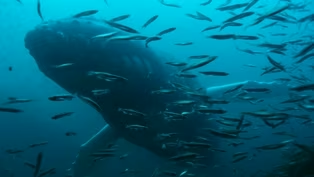
CGI timelapse reveals the birth of an ecosystem in a formerly frozen region of Alaska. (1m 48s)
Providing Support for PBS.org
Learn Moreabout PBS online sponsorship
- Science and Nature

Explore scientific discoveries on television's most acclaimed science documentary series.

- Science and Nature

Capturing the splendor of the natural world, from the African plains to the Antarctic ice.










Support for PBS provided by: