
Iowa Farmer Turns Cornfields into Vineyards
Clip: 5/4/2026 | 5m 50sVideo has Closed Captions
Iowa is definitely where the corn grows, but these Iowa farmers are making Hawkeye State wine.
Iowa is definitely where the tall corn grows, but these Iowa farmers are making a special kind of Hawkeye State wine.
Problems playing video? | Closed Captioning Feedback
Problems playing video? | Closed Captioning Feedback
America's Heartland is presented by your local public television station.
Funding for America’s Heartland is provided by US Soy, Sustainable Agriculture Research and Education, Rural Development Partners, and a Specialty Crop Grant from the California Department of Food and Agriculture.
Iowa Farmer Turns Cornfields into Vineyards
Clip: 5/4/2026 | 5m 50sVideo has Closed Captions
Iowa is definitely where the tall corn grows, but these Iowa farmers are making a special kind of Hawkeye State wine.
Problems playing video? | Closed Captioning Feedback
How to Watch America's Heartland
America's Heartland is available to stream on pbs.org and the free PBS App, available on iPhone, Apple TV, Android TV, Android smartphones, Amazon Fire TV, Amazon Fire Tablet, Roku, Samsung Smart TV, LG TV, and Vizio.
Providing Support for PBS.org
Learn Moreabout PBS online sponsorship>> Everybody knows that Iowa is corn country.
In fact the Hawkeye state is the number one corn producing state in the nation.
But just like our California sweet potato grower, one Iowa farm family decided that their land might be used for something quite different.
>> The bottling crew is hard at work early this summer morning at Ardon Creek Vineyard and Winery.
This all volunteer crew is critical to the operation in more ways than one.
In fact this farm is as much about this gathering of friends as it is the wine grapes growing out back.
>> To understand the "vibe" of Ardon Creek you have to understand it's founders, Mike and Dianne Furlong.
They both grew up on farms but left for non-agriculture jobs, and now they're back on the family farmstead, not relaxing.
>> Well, I don't relax very well but uhm.., and the internet never works out here anyways.
>> After success in their chosen fields, just over 10 years ago they got interested in winemaking.
Not long after that, they decided to plant a few acres of grapes.
And the perfect place to do it was Mike's family farmstead that's been in his family since the 1800s.
>> The property we're on here, this 40 acres, was uh.. settled by the Furlongs in 1855 and they had migrated across New York and Ohio for about five years after the potato famine in Ireland.
And so, we have kind of an interesting endeavor in the middle of a corn/soybean state, but we think diversity is good and we hope other people do as well.
>> Mike's cousin Tom is what you might call a typical Iowa farmer.
He grows corn and soybeans and raises cattle just down the road.
>> Now, obviously this area is a, I would say a more traditional type of area.
Uh.. , were there any naysayers that said a winery in Letts, Iowa?
>> Well, I think there's, when anybody else starts a new business you always have those people that think uh.. , you've got your pretty crazy and so crazy idea and that it won't make it.
But, you know, I think also good that uh.., somebody is willing to take that and add a little diversity to the community.
So it was good to see that somebody was going to try something different.
>> But with risk, sometimes comes great reward.
And the Furlongs say their reward comes whenever a new customer stops by their wine shop to pick up a bottle.
>> It's pretty exciting.
The thing I like to ask them is where are you from and how did you find us or hear about us or have you tasted our wine?
>> They bottle both reds and whites, mostly sweeter wines, preferred in this region.
The Furlongs also make wine out of grape juice from New York's Finger Lakes region.
>> Do you have a favorite uh, varietal that they uh, serve up here?
>> Well, I like their uh, Commission Man Red, that's my favorite.
It's a little bit of a dry red, but uh, they're all uh, have their unique taste.
>> Meanwhile, those volunteers are hard at work inside.
>> How's it going?
>> Oh, it's going good today.
Started off a little slow.
We didn't have enough people, but it's going good now.
>> How many of these do you do in a minute?
You're kind of cranking them out.
>> Oh, I don't know by the minute.
We try to do 400 an hour, if things are, if things are going good.
So we'll divide that by what, 60, I guess.
>> And this is just, it just drops that cork right in there.
>> And that's it.
>> All right, here we go.
Tell me if I'm doing this right.
Check the wine level.
>> Yep, there ya go.
Check it and stick it in there.
Keep your fingers on it; your thumbs on it.
Oop, okay now let, now let it go.
There ya did it.
>> Look at that!
>> Yep, send it on.
>> Oh, I'm - I'm slowing them down.
I'm sorry.
>> Do - do another one.
>> Oh, I didn't check this one.
>> Eh, it's good.
>> Does that look all right?
>> Looks like there's a little extra in that one.
>> That's fine.
Extra's good.
Short's bad.
>> Lucky uh.. wine customer.
>> There ya go.
>> Yeah.
>> Look at that!
>> Yeah, nothing to it.
>> And Mike and Diane say they value this crew, and not just because it's free labor.
But they see it as something more, something that's been lost as Iowa farming has become more mechanized.
>> We both grew up on family farms with aunts and uncles and cousins all in a row and all together and everybody would come to vaccinate hogs, bale hay, whatever it was and that is gone in the farming community today.
>> And so, by doing the grapes what we've been able to do is have all kinds of people come and help plant the grapes, harvest the grapes and now bottle the juice so it's a way to get people together in agriculture.
>> And we will be introducing the Nuvaux... >> And while some people look for relaxation in retirement, the Furlongs insist this was never intended to be a hobby.
Proof?
They sell 27,000 bottles a year.
It's a business, with few days off.
>> We talked about a vacation in January; it ended up being one night [laughs] in another part of Northern Iowa.
>> Again, I'm a giver [laughs] >> There's a long history of winemaking in Iowa.
Western Iowa was home to commercial vineyards and wineries as far back as the 1850's.
As with many states, prohibition played a major role in curtailing Iowa wine production in the early 20th century.
And don't just think about grapes in the Iowa winemaking story.
Many vintners create distinctive wines from apples, berries and even honey, rhubarb and dandelions.
And, while we talk alcoholic beverages, since Iowa is the number one corn producing state in the nation, small scale mini distilleries have sprung up to transform Hawkeye corn into distilled spirits like bourbon.
♪♪
 New
NewVideo has Closed Captions
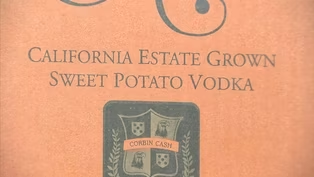
In California, sweet potatoes are the secret ingredient in award-winning vodka. (5m 22s)
 New
NewFarm to Fork: Candied Orange Salad
Video has Closed Captions
On Farm to Fork, we’ll learn how to make a sweet salad featuring candied oranges. (6m 43s)
 New
NewVideo has Closed Captions
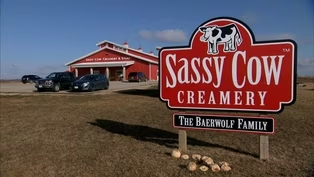
In Wisconsin, some “sassy cows” create special kinds of cheese and ice cream. (4m 33s)
Providing Support for PBS.org
Learn Moreabout PBS online sponsorship
- Food
Christopher Kimball’s Milk Street Television
Transform home cooking with the editors of Christopher Kimball’s Milk Street Magazine.






Support for PBS provided by:
America's Heartland is presented by your local public television station.
Funding for America’s Heartland is provided by US Soy, Sustainable Agriculture Research and Education, Rural Development Partners, and a Specialty Crop Grant from the California Department of Food and Agriculture.