
January 14, 2026 - PBS News Hour full episode
1/14/2026 | 57m 46sVideo has Closed Captions
January 14, 2026 - PBS News Hour full episode
Wednesday on the News Hour, as the unrest continues in Iran, President Trump seems to tamp down his threats of military action. Disagreements remain after a meeting between the White House and officials from Denmark and Greenland, a territory Trump wants to control. Plus, more immigration raids and the ongoing fallout from the killing of a U.S. citizen by an ICE agent keep the Twin Cities on edge.
Problems playing video? | Closed Captioning Feedback
Problems playing video? | Closed Captioning Feedback
Major corporate funding for the PBS News Hour is provided by BDO, BNSF, Consumer Cellular, American Cruise Lines, and Raymond James. Funding for the PBS NewsHour Weekend is provided by...
Support provided by:

January 14, 2026 - PBS News Hour full episode
1/14/2026 | 57m 46sVideo has Closed Captions
Wednesday on the News Hour, as the unrest continues in Iran, President Trump seems to tamp down his threats of military action. Disagreements remain after a meeting between the White House and officials from Denmark and Greenland, a territory Trump wants to control. Plus, more immigration raids and the ongoing fallout from the killing of a U.S. citizen by an ICE agent keep the Twin Cities on edge.
Problems playing video? | Closed Captioning Feedback
How to Watch PBS News Hour
PBS News Hour is available to stream on pbs.org and the free PBS App, available on iPhone, Apple TV, Android TV, Android smartphones, Amazon Fire TV, Amazon Fire Tablet, Roku, Samsung Smart TV, and Vizio.
Providing Support for PBS.org
Learn Moreabout PBS online sponsorshipAMNA NAWAZ: Good evening.
I'm Amna Nawaz.
GEOFF BENNETT: And I'm Geoff Bennett.
On the "News Hour" tonight: As the unrest continues in Iran, President Trump appears to tamp down his own threats of military action.
AMNA NAWAZ: Fundamental disagreements remain after a meeting between the White House and officials from Denmark and Greenland, a territory the president has said the U.S.
should control.
GEOFF BENNETT: And more immigration raids and the ongoing fallout from the killing of a U.S.
citizen by an ICE agent keeps the Twin Cities on edge.
NIMCO OMAR, Minneapolis Resident: This morning, when I left my house, I was like, am I going to see ICE?
I don't know.
Are they going to arrest me?
I don't know.
And that's what the entire Somali community and the community of color are feeling now.
(BREAK) AMNA NAWAZ: Welcome to the "News Hour."
For days, fears and tensions have racked the Middle East.
And we're witnessing unprecedented protests in Iran, a deadly crackdown by Iranian authorities and threats to intervene by President Trump.
GEOFF BENNETT: But, tonight, President Trump said Iran's crackdown had eased and suggested his focus was no longer a military strike.
Nick Schifrin is here following all of this for us.
So, Nick, what did the president say this afternoon?
NICK SCHIFRIN: The president said that the killing in Iran is -- quote -- "stopping" and that Iran would not follow through on the first execution of a protester, which we expected today.
And this is crucial, Geoff, because the president for days has been warning Iran, threatening Iran that, if Iran killed protesters, which Iranian forces have done by the thousands, and that if Iran went through with that execution that we expected -- quote -- "We will take very strong action."
So, by saying this today, the president at least appears to be no longer focused on a military strike.
QUESTION: Does this mean military action is now off the table against Iran?
DONALD TRUMP, President of the United States: Well, we're going to watch and see what the process is, but we were given a very good statement by people that are aware of what's going on.
QUESTION: Are you still considering military action?
Is that still a threat?
DONALD TRUMP: Well, if there are no executions -- everybody was talking about a lot of executions were taking place today.
We were just told no executions.
I hope that's true.
NICK SCHIFRIN: The president even went so far as to say that protesters in Iran have been shooting back.
That is a point that the Iranian government has been making, that hundreds of security forces have been killed during these protests.
So what's actually happening on the ground, Geoff?
Last night, we spoke to an Iranian inside Iran who said that there have been fewer protests over the last few days, but only because the crackdown has been so ruthless.
Activists say at least 2,500 people, perhaps many times that, have been killed.
And, simultaneously, Iran launched an unprecedented Internet crackdown.
So take a listen now to human rights activist Roya Boroumand, who leads the Abdorrahman Boroumand Foundation.
ROYA BOROUMAND, Abdorrahman Boroumand Center for Human Rights in Iran: They have been very brave, but there is a point where they ask themselves, OK, we are going out and, each time, one-third of us is not coming back.
They have used either machine guns or similar arms to kill in numbers.
So that means that people who have come out have seen a lot of deaths.
I don't think this is over, but I think that it will calm down for a while.
NICK SCHIFRIN: As Boroumand put it tonight, Geoff, people are focused on counting and burying the dead.
GEOFF BENNETT: And, Nick, what have you learned about the military preparations for this moment and how the U.S.
perceives the threat?
NICK SCHIFRIN: Yes, so let's talk about short term.
The short term for the U.S.
has been the protests, of course.
And a U.S.
official tells me that the military response that they have been considering really goes from a range of light to heavy.
Light could be an attack on the security forces that are specifically targeting, specifically killing these protesters.
The idea would be to send the message to these protesters, we know who's killing you and we have got your back.
The medium option would be to expand that.
And that would -- to go after all security forces in Iran, clearly trying to destabilize the regime and the security forces themselves.
And the heavy, that would be to target Iran's nuclear and missile program.
That would go well beyond the protests, of course.
A U.S.
official also tells me tonight that the U.S.
believes that Iran's response to a U.S.
military strike would be heavier than what we have seen in the past.
Iran's attack last June on the U.S.'
largest base in the Middle East -- you see that there last June, Al Udeid in Qatar -- all of those missiles were shot down, Geoff.
And that's why you saw the U.S.
acknowledge today that they partially evacuated Al Udeid because of that threat.
But, again, long term, there are other considerations that the U.S.
is really focused on, same goals as before, an Iran without a nuclear program, an Iran without ballistic missiles, an Iran without funding terrorism across the region.
And on those missiles, recently, the DIA said that, by 2035, Iran could have 60 intercontinental ballistic missiles.
Today, it has zero.
And so, in the long term, that is what the U.S.
is focused on.
And, clearly, if the president has taken military action off the table, at least for now, right now, that is still what the U.S.
is going to focus on, making a deal over nuclear weapons and missiles.
GEOFF BENNETT: Meantime, Nick, U.S.
officials announced they're moving to phase two of the cease-fire between Israel and Hamas.
What does that look like in real terms?
NICK SCHIFRIN: Yes, very quickly, senior U.S.
officials just got off the phone with reporters announcing tonight that they had technical governance set up for Gaza and that the president was going to be sending out invitations to join the Board of Peace.
That's what will oversee Gaza's reconstruction.
The vague idea, taking a look at the map for how this would work, you have this yellow line in Gaza, which you see right there.
Phase two, the idea is to rebuild Eastern Gaza.
On the right there, you see in the red allowing Palestinians to cross over from the west to the east.
And the idea is that, as they cross, they would be handing their weapons over through some kind of gun buyback.
But that is very far where we are now -- from where we are now.
The reconstruction of Gaza, you look at that.
Rafah, that looks like a moonscape right now.
The other challenge, of course, Hamas has not agreed to demilitarize.
U.S.
hoping that today's announcement at release will show they have got momentum toward governance, even if they don't have a final deal to demilitarize Hamas.
GEOFF BENNETT: Nick Schifrin, our thanks to you, as always.
NICK SCHIFRIN: Thank you.
AMNA NAWAZ: President Trump said today that he hoped for a resolution on his threat to annex Greenland.
That followed Vice President Vance and Secretary of State Rubio meeting with the foreign ministers of Denmark and Greenland at the White House this morning.
But Trump again registered his concern about a perceived threat to Greenland from Russia and China.
DONALD TRUMP, President of the United States: Greenland is very important for the national security, including of Denmark.
And the problem is, there's not a thing that Denmark can do about it if Russia or China wants to occupy Greenland.
But there's everything we can do.
AMNA NAWAZ: Danish Foreign Minister Lars Lokke Rasmussen said after the meeting that a working group would be established to discuss a broad range of issues.
He also said it was clear that he and his colleague did not manage to change the American position and that it remains clear that Trump wishes to conquer Greenland.
But the people in Greenland and NATO member Denmark reject that.
And the threat has deeply rattled the rest of the alliance.
For more on all of this, we turn now to retired Dutch Admiral Rob Bauer.
From 2021 until January of 2025, he was the chair of the Military Committee of NATO.
Admiral Bauer, welcome to the "News Hour."
Thanks for joining us.
ADM.
ROB BAUER (RET.
), Royal Netherlands Navy: Amna, good evening.
AMNA NAWAZ: So let's just start with your reaction to those meetings today between Danish and Greenland officials and the Trump administration, and the Danish foreign minister saying there are fundamental disagreements that remain between the parties.
ADM.
ROB BAUER (RET.
): Well, those remarks are for him, of course, but this is not a new thing.
The United States tried to -- a president in, I think, 1867 or something tried to buy Greenland already.
And so this is a longstanding wish from the U.S.
to have more influence in Greenland.
And that is because of the strategic positioning of the geography of Greenland.
If you look at the map from the Polar Circle, then basically you see that Greenland is in between Russia and the United States.
And what we see as a result of the global warming is that the waters north of -- or the polar - - in the polar region are warming up.
And, therefore, the ice is melting.
And those waters will become navigable.
And that is good news for the merchant vessels that China wants to use to bring its goods that it produces to Europe and the United States.
But if merchant vessels can navigate through those waters, then also naval vessels can navigate through those waters.
And that would bring -- that would allow the Chinese and Russian Pacific fleet to actually come to the North Atlantic much faster than via any other route.
And that is, of course, a strategic risk.
AMNA NAWAZ: May I ask you, though, about the perceived threat right now?
Because let me just play for you how the -- President Trump talks about the threat from Russia and China at this moment.
Here's what he said this week.
DONALD TRUMP: We need that because, if you take a look outside of Greenland right now, there are Russian destroyers, there are Chinese destroyers and bigger, there are Russian submarines all over the place.
We're not going to have Russia or China occupy Greenland, and that's what they're going to do if we don't.
AMNA NAWAZ: Also, Admiral, today, the Danish foreign minister said this on that same topic.
Take a listen.
LARS LOKKE RASMUSSEN, Danish Foreign Minister: It is not a true narrative that we have Chinese warships all around the place.
According to our intelligence, we haven't had a Chinese warship in Greenland for a decade or so.
AMNA NAWAZ: So, Admiral, who is right on this?
When you look at the landscape right now, are there Russian and Chinese warships all around Greenland, as President Trump says?
ADM.
ROB BAUER (RET.
): I hope you understand that, since I left NATO, I am not privy to -- any longer to intelligence as I was in that job.
So I can't compete with the people in office, both in Denmark and the United States.
But what I do know is that the Russians are allowing the Chinese to enter their waters.
And they are doing this for a couple of years already.
They have combined air patrols with long-range reconnaissance aircraft from both air forces, Russian and Chinese.
They operate together with their coast guards.
And this is not just to study polar bears, as General Grynkewich, the supreme allied commander of Europe, said.
This is to prepare militarily as well.
So this is preparing the grounds.
This is getting to know the grounds.
This is gaining intelligence, gaining experience in difficult waters, difficult weather.
And so, for the Chinese, this is a great opportunity, where the Russians for a very long time didn't allow anyone in those waters.
And now, as they are becoming more and more of the little nephew in that relationship because of their dependence on China, because of the Ukraine war, where China basically not only gives political support, but also all the raw materials and the parts for the weapons and sensors and ammunition that Russia is building for that war.
So the Russians are so dependent on China that they have to allow China into the Arctic.
And I think that is what President Trump is so worried about, that it is not only Russia that is patrolling those waters and is getting access to those waters, but it is increasingly also China.
AMNA NAWAZ: So, as I'm hearing you saying there's a growing threat and there could be a threat, a growing threat against Greenland, would Article 5 protections extended from Denmark, which is a NATO ally, would those not be enough to protect Greenland?
Or do you support President Trump's argument that it needs to be under U.S.
control to be adequately protected?
ADM.
ROB BAUER (RET.
): I don't think it's necessary that it is under U.S.
control.
This is a territory of the Danish kingdom.
Greenland is part of that.
And so it is part of the Danish kingdom.
And, therefore, it is up to Denmark, and together with Greenland, to work on that.
But in terms of the strategic importance of Greenland and the waters around it, I understand what President Trump is saying.
I cannot comment on the intelligence, what he is referring to.
But I agree with him that, increasingly, the Arctic is an area where there is no longer high north low tensions.
This is an area where we will see rising tensions in the next couple of decades because of the strategic importance, the melting ice, and also, of course, all the raw materials that are available there, oil, gas, but also a lot of other stuff that can be found there.
It's a rich area in many, many areas.
So I think that is the reason why everybody's concerned.
And that is the reason why now NATO is - - if you listen to the secretary-general of NATO, Mark Rutte, he's talking about a new activity, Arctic sentry, where more and more NATO members can join for activities in and around Greenland to make sure that we have eyes on what is happening there with the Russians and the Chinese.
AMNA NAWAZ: Admiral, I have less than 30 seconds left, but I have to ask you.
It's a strange situation here with the U.S.
threatening to annex Greenland.
Would that trigger -- U.S.
action in Greenland, would that trigger a NATO response?
Are you worried about the strength of the alliance here?
ADM.
ROB BAUER (RET.
): I think the United States needs a stable and secure Arctic, as they need a stable and secure Atlantic Ocean and as they need a stable and secure Europe.
And I think NATO is too important for the U.S.
to have it fall apart as a result of an attack from one ally on another.
So I think it is that bad, the results of such an attack, that it will not be in the interest of the U.S.
to do that.
So I think NATO is too important to let this happen.
AMNA NAWAZ: That is retired Dutch Admiral Rob Bauer joining us tonight.
Admiral, thank you so much.
Good to speak with you.
ADM.
ROB BAUER (RET.
): Good night.
GEOFF BENNETT: In the day's other headlines: The Trump administration is suspending the processing of visa applications for citizens from 75 countries.
That includes green cards, fiance visas, and certain kinds of work visas.
Among the countries listed by the State Department today are Afghanistan, Brazil, Colombia, Egypt, Iran, and Russia.
In a statement, the State Department said the pause is meant to prevent the entry of foreign nationals who would take welfare and public benefits.
The new policy starts January 21.
It will not apply to those seeking nonimmigrant visas or temporary tourist or business visas.
Michigan Senator Elissa Slotkin says she is under federal investigation for her involvement in a video telling U.S.
troops to resist illegal orders.
The Iraq War veteran and former CIA analyst organized the November video in which she and five other Democratic lawmakers told military personnel not to follow orders if they are unlawful.
President Trump and his aides have called that video seditious.
In a video posted to social media today, Slotkin said the president is using the federal government to go after his critics.
SEN.
ELISSA SLOTKIN (D-MI): To be clear, this is the president's playbook.
Truth doesn't matter, facts don't matter, and anyone who disagrees with him becomes an enemy and he then weaponizes the federal government against them.
It's legal intimidation and physical intimidation meant to get you to shut up.
GEOFF BENNETT: Three other lawmakers who appeared in that November video also confirmed today that they have been contacted by Trump officials.
It comes just days after Arizona Senator Mark Kelly said he's suing the Pentagon over its efforts to punish him over his involvement.
The U.S.
Supreme Court today revived a Republican congressman's challenge to an Illinois law that allows mail-in ballots to be counted after Election Day.
The case was not about the ballots themselves, but whether candidates like Congressman Mike Bost have the right to such challenges.
The state had argued that allowing the suit would open the door to more election-related cases.
The court also sided with police today in a case that would allow officers to enter a home without a warrant in emergencies.
It stems from an incident in Montana involving an Army veteran who police feared was suicidal.
In Thailand, at least 32 people were killed today when a construction crane collapsed onto a moving passenger train, causing it to derail.
The crash site was a mess of mangled steel with crushed railway cars scattered along the tracks.
The enormous red crane was being used to construct an elevated section of a new high-speed rail project.
On the ground, rescue teams scoured the wreckage for survivors and tended to some of the 60 people who were injured.
Eyewitnesses recalled how it all unfolded.
SAMAI TEECHANTUEK, Witness (through translator): I heard the noises screeching and then bam, bam, bam.
When the dust settled, I saw the top of the train carriage.
I heard people shouting, "Save the children first."
I saw them pulling many people out.
GEOFF BENNETT: Thailand's prime minister visited the scene after the crash and called for an investigation.
Verizon says its engineers are working today to identify and solve a nationwide outage to its wireless data and voice services.
According to the tracking Web site Downdetector, more than 180,000 users reported outages at one point today from Seattle to Atlanta to Boston.
Many users reported showing zero bars on their phone or SOS, which indicates no connection accepts to make emergency calls.
But New York emergency officials said the outage even affected some users trying to call 911.
The U.S.
housing market slumped for a fourth straight year in 2025.
The National Association of Realtors said today that the number of existing homes sold last year totaled just over four million, virtually unchanged from 2024 and still at 30-year lows.
It comes as prices remain high.
The median home price for all of last year rose to around $414,000.
There are signs of hope, though.
Sales last month were the strongest in nearly three years when taking into account seasonal factors.
Luxury retailer Saks Global filed for bankruptcy protection today.
The parent company of retailers like Saks Fifth Avenue and Bergdorf Goodman has been struggling amid increased competition and a heavy debt load following its acquisition of Neiman Marcus in 2024.
Saks says its stores will stay open as it restructures under bankruptcy protection.
Meantime, on Wall Street today, stocks were down as bank and tech shares took a hit.
The Dow Jones industrial average slipped around 40 points.
The Nasdaq dropped more than 200 points.
The S&P 500 also ended lower on the day.
Still to come on the "News Hour": an FBI raid of a reporter's home raises concerns about the intimidation of the free press; pressure and partisan divides build in Congress over several major pieces of legislation; and how a small tweak to U.S.
laws could have a huge impact on hemp products.
AMNA NAWAZ: It's been just over a week since an ICE agent fatally shot 37-year-old Renee Good in Minneapolis, setting off large protests in the Twin Cities and nationwide.
Since then, the presence of immigration enforcement officials has only grown, leaving Minnesota communities on edge.
Special correspondent Fred de Sam Lazaro begins our coverage with this report.
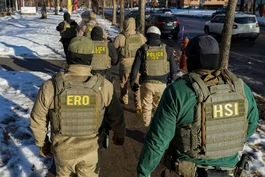
FRED DE SAM LAZARO: The images are now familiar across the Twin Cities, federal agents making a stop, observers rushing to the scene with whistles and car horns, scuffles breaking out, with agents deploying pepper spray or tear gas, and an endless standoff between protesters and officers at the federal building which serves as a base for the immigration crackdown here.
MAN: It's unconscionable to not stand up and say this is wrong.
This is part of democracy.
FRED DE SAM LAZARO: In recent days, hundreds of additional agents have been sent to Minnesota on top of the roughly 2,000 already on the ground.
That's more than the size of the Minneapolis and St.
Paul police departments combined.
In a statement to the "News Hour," the Department of Homeland Security says it's made over 2,000 arrests throughout its largest operation in history, adding -- quote -- "This is just the tip of the iceberg."
Meanwhile, in a TRUTH Social post today, President Trump said he's cutting off federal funds to so-called sanctuary states.
That's after saying on Tuesday -- quote -- "Fear not, great people of Minnesota.
The day of reckoning and retribution is coming."
Fears have risen steadily in Minneapolis and St.
Paul since Renee Good's killing.
Business at many local immigrant-owned shops has plummeted in recent weeks, down in some areas at least 80 percent, according to one report.
DHS told the "News Hour" -- quote - - "Removing dangerous criminals from our streets makes it safer for everyone, including business owners and their customers."
At the Park Avenue Church, just steps from where Good was shot, the tension is palpable.
REV.
JENNIFER IKOMA-MOTZKO, Pastor, Park Avenue United Methodist Church: We gather today with heavy hearts.
FRED DE SAM LAZARO: Jennifer Ikoma-Motzko is a pastor at the more-than-100-year-old church.
Her grandmother was one of more than 120,000 Japanese-Americans interned during World War II.
REV.
JENNIFER IKOMA-MOTZKO: My legacy is to call people of all different backgrounds to fight now for who are the marginalized, who is being targeted right now.
FRED DE SAM LAZARO: Just as I asked Ikoma-Motzko about what comes next, we were interrupted by the sounds of car horns and whistles outside.
Agents were raiding a house across the street from the church, and a crowd had gathered.
When officers emerged with two handcuffed young men, tempers flared.
Agents fought with observers.
They deployed pepper spray, tear gas and flashbangs, as Ikoma-Motzko watched nearby.
At one point, a woman tried to drive past the scene.
Authorities smashed her window, dragged her from the car and detained her.
She shouted that she was on her way to a doctor's appointment.
The episode lasted more than 45 minutes.
And, when it was over, local resident Will Vermie was gone.
His wife, Heather Mains, believed he was one of the first people arrested.
HEATHER MAINS, Minneapolis Resident: I'm worried about Will, but I also -- I know he will be fine.
He's a citizen.
For the folks who don't have those privileges, I can't even imagine what they felt in this situation.
FRED DE SAM LAZARO: Vermie was released after about eight hours at the federal building without being charged, bruised, but otherwise all right.
WILL VERMIE, Minneapolis Resident: They were asking people to move back.
I guess I wasn't quick enough for them.
This didn't appear to be a well-run operation inside the building.
We were walking through.
And the agents that were escorting me didn't actually have the ability to get into the detention area.
They had to wait for someone to let them in.
FRED DE SAM LAZARO: DHS said agents ultimately detained four -- quote -- "illegal aliens" who now face removal proceedings.
It said the crowd impeded operations and that the woman in her car ignored multiple commands by an officer to move her vehicle and was arrested for obstruction.
In all, six -- quote -- "agitators" were taken into custody for assaulting law enforcement.
PBS News' Liz Landers asked White House border czar Tom Homan about the incident.
LIZ LANDERS: There are Americans who see this and say this looks like Putin's Russia.
What is your response to that?
TOM HOMAN, White House Border Czar: You know, if they would let us in their damn jail and stop being a sanctuary city, we could arrest the bad guy in the safety and security of a jail.
But because they normally release them, now we got to go in the community and find them.
Then they're mad we're in the community.
FRED DE SAM LAZARO: Were you surprised at what unfolded right outside your church?
REV.
JENNIFER IKOMA-MOTZKO: It was a battle scene.
I had this moment where I didn't bring my cell phone, and I just lifted up what I had and I lifted up my hand.
And I looked over and I saw a neighbor I didn't know lifting up the middle finger.
There is protesting, there's observing, and there is prayer, and all is going to be needed.
FRED DE SAM LAZARO: But now, as the crackdown widens, many Twin Cities residents, including U.S.
citizens, fear they could be targeted.
NIMCO OMAR, Minneapolis Resident: I was going this way.
FRED DE SAM LAZARO: Like Nimco Omar, who was surrounded by at least three federal agents on a sidewalk Sunday.
NIMCO OMAR: I was like, what is happening?
What did I do?
Because, at the first, I wasn't thinking ICE.
I was able to take out my phone because, in case they kidnap me, so later on there was something at least.
So that's why I recorded it.
MAN: All right, can we see an I.D., please?
NIMCO OMAR: I am U.S.
citizen.
I don't need to carry around an I.D.
in my home.
MAN: Well, where were you born?
NIMCO OMAR: This is my home.
This is my home.
MAN: Where were you born?
NIMCO OMAR: Minneapolis is my home.
FRED DE SAM LAZARO: The agents ultimately left after one of them took a picture of Omar, seemingly checking it against a government database.
NIMCO OMAR: This is my home.
This is where I belong.
In a quiet Minneapolis neighborhood, I should not be seeing a soldier walking and asking to give him identification.
FRED DE SAM LAZARO: DHS told the "News Hour" -- quote -- "Those who are not here illegally and are not breaking other laws have nothing to fear."
But after agents left Omar on Sunday, she said she was shaking and began to cry.
The shock has stuck with her.
NIMCO OMAR: This morning, when I left my house, I was like, am I going to see ICE?
I don't know.
Are they going to arrest me?
I don't know.
And that's what the entire Somali community and community of color are feeling now.
FRED DE SAM LAZARO: For the "PBS News Hour," I'm Fred de Sam Lazaro in Minneapolis.
AMNA NAWAZ: And Fred's reporting is a partnership with the Under-Told Stories Project at the University of St.
Thomas in Minnesota.
For more on ICE's operations in Minnesota, I'm joined now by the state's attorney general.
That is Keith Ellison.
Attorney General Ellison, welcome back to the "News Hour."
Thanks for joining us.
KEITH ELLISON, Minnesota Attorney General: Thanks for having me.
AMNA NAWAZ: So, I want to begin with a little legal news today, because I know your office had asked a federal judge to temporarily block a surge of ICE agents to the Minneapolis area.
The judge declined to rule today, giving DOJ until Monday to respond.
So does that mean that another surge of agents is on their way?
And what are you anticipating in the way of the size and scope of that new surge?
KEITH ELLISON: Well, it certainly does mean that they have a little bit more time to search, which concerns me, because the searching they have done so far has been destructive, not helpful to anybody.
It has risked public safety.
It has depleted public resources.
It has increased fear.
And It has eroded Americans' confidence in their government and has been a whole -- wholly a failure in every conceivable way.
So I am a little disappointed.
But I believe that this is a wonderful judge, who's a deeply thoughtful person, who really just wants to make sure the best decision she can make.
And that takes time.
No doubt, however, that, as time is of the essence, right, and we need relief from this surge, this dramatic escalation founded on lies and untruths, which is doing so much damage.
AMNA NAWAZ: I also want to put to you another piece of news today.
We heard from the Border Patrol, Bovino, who said on FOX the Department of Justice is also sending additional prosecutors to Minnesota to process those immigration cases.
What's your reaction to that?
KEITH ELLISON: Well, I mean, quite honestly, I mean, it -- I'm not shocked, because the -- President Trump is making sure that he is targeting our state, which is odd because we are not a state that has the most immigration in America.
Many other states have dramatically higher rates of immigration than we do.
We do have some, and we're very proud of our neighbors who've chosen to make America their home.
But I guess I'm not surprised that we're getting unwarranted, unasked-for attention from President Trump.
He's made it very clear that, because he believes that he won Minnesota three times, but in fact lost it, he's upset about that, has repeated that numerous times.
So we expect the persecution will continue while he operates the way he's operating.
AMNA NAWAZ: You heard there the border czar... (CROSSTALK) AMNA NAWAZ: Sorry.
Go ahead.
KEITH ELLISON: Or until a court tells him he can no longer do it.
AMNA NAWAZ: Well, you probably heard in our report there the border czar Tom Homan telling my colleague Liz Landers that this is about what they call their your sanctuary policies in Minnesota and Minneapolis.
Specifically, there is this idea of not honoring an ICE detainer, meaning, if there's an undocumented person in city or state custody in Minnesota, they're not handed over to ICE.
And I do want to point out that you did issue in an informal opinion last year, you wrote that Minnesota law prohibits law enforcement from holding someone on an immigration detainer if the person would otherwise be released from custody.
So what does that otherwise released from custody mean?
Do you ever hand people over to ICE or not?
KEITH ELLISON: Well, what it means is that we comply with the law and the Constitution of the United States of America and the state of Minnesota.
And I would submit to you that Minnesota is not a sanctuary city.
We have never claimed to be a sanctuary city.
We have never claimed to be a sanctuary state.
What we do is, we devote all of our state resources to state matters and that the federal government has its responsibility.
We don't interfere with them, but we don't devote state resources to federal projects like immigration enforcement.
So we don't really -- so this idea of some sort of a sanctuary state is a misnomer.
We have never claimed that.
And I think it's wholly - - I think the voters and the taxpayers of our state expect that the resources of our state will be devoted for the purposes of our state and that the federal government, they're paid to do their job and we don't interfere with them doing it.
We also don't do their job for them.
AMNA NAWAZ: Before we go, I want to briefly ask you too about the ongoing investigation into the shooting and killing of Renee Good by an ICE agent.
I know Minnesota officials were shut out of the federal investigation.
Your office has since launched essentially a parallel probe.
You have probably seen the news of DHS saying that the ICE officer was injured and suffered internal bleeding.
My question to you is, are you going to have any access to any of these medical records, the agent, any other evidence, body camera footage?
And, if not, how can your office carry out a thorough investigation on this issue?
KEITH ELLISON: Well, I will just point out that all we have been asking for is a fair, free, open investigation.
How they would make such a claim without producing a medical record to prove it I find curious and why in the world they would not just do the investigation.
We have heard that the Department of Justice Civil Rights Department has been excluded from doing the investigation.
These people know the most about these cases in the federal government, yet they're not doing the case.
And at the same time, they're reject -- they're stopping the state from doing the work that we're supposed to do.
I do not necessarily take the word of those people.
I will take the word of a trained medical professional who's made a diagnosis and a medical record made for the purpose of diagnosis and medical treatment.
But I'm not going to just take the word of some nameless, faceless bureaucrat who's just -- I don't know.
But, I mean, let me just say this.
I find it interesting that the federal government, the federal authorities shut the state of Minnesota out from the investigation, will not let the most expert people in their own institution investigate the case, but like to -- like to send out little pieces of information that they believe benefit them, like the video that is purported to be from Jonathan Ross and now this non-medical personnel giving testimony or giving public statements about medical conditions.
So I will stop right there.
AMNA NAWAZ: That is Minnesota's Attorney General Keith Ellison joining us tonight.
Thank you.
It's good to speak with you.
KEITH ELLISON: Thank you, ma'am.
In a highly unusual move, the FBI searched the home of a Washington Post reporter as part of an investigation involving a government contractor accused of mishandling classified information.
Agents executed a search warrant at the home of Hannah Natanson, who has been reporting on President Trump's overhaul and downsizing of the federal government.
They seized her phones, laptops, and a smartwatch, though agents reportedly told Natanson she is not the target of the investigation.
The inquiry centers on a system administrator in Maryland who has been charged with unlawful retention of national defense information.
Press freedom advocates are sharply criticizing the search, warning it represents a dangerous escalation that threatens investigative journalism and raises serious First Amendment concerns.
We're joined now by Gabe Rottman, vice president of policy at the Reporters Committee for Freedom of the Press.
Thanks for being here.
GABE ROTTMAN, Vice President of Policy, Reporters Committee for Freedom of the Press: Thanks for having me.
GEOFF BENNETT: So the criminal complaint against this contractor does not mention any ties to The Washington Post reporter, yet the attorney general, Pam Bondi,on X said that the search was requested by the Pentagon "at the home of a Washington Post journalist, who was obtaining and reporting classified and illegally leaked information from a Pentagon contractor."
So what questions does that raise and what concerns does the FBI search of her home trigger more broadly?
GABE ROTTMAN: Well, so I think there's two points to make there.
One, it is notable that the attorney general is pointing out that the Department of Justice has a suspect in custody and in fact has charged that suspect.
And so it raises the question as to why the Justice Department and the FBI would take the extraordinary step of executing a search warrant at the home of a reporter and seizing her electronic devices.
The other point that I would make here is that this is actually something that we haven't seen before.
Again, we're talking about the FBI raiding the home of a journalist in a national security leak case.
At the Reporters Committee for Freedom of the Press, where I work, we track these cases closely.
We are not aware of another case where the Justice Department has executed a search warrant in a national security leak case against a journalist or against a news outlet.
It's unprecedented.
GEOFF BENNETT: And we hadn't seen this before because Attorney General Pam Bondi reversed protections that had previously discouraged such seizures.
Is that right?
GABE ROTTMAN: So the closest analog to this case that we're aware of is a then-FOX News correspondent named James Rosen who had a search warrant executed for his e-mail back in 2010 during the first Obama administration.
That was hugely controversial at the time.
It led the department to reform its existing policies on how it handles these types of investigative steps.
But I think what's really important to note is that, even in that case, we were talking about two days' worth of e-mail.
Here, the Justice Department has seized her work computer, home computer, her phone, and a smartwatch.
And the volume of that information is orders of magnitude more than what they got in the Rosen case.
The other thing to note about the Rosen case is that one of the reasons it was controversial is because there's a federal law passed in 1980 that is supposed to restrict the ability of law enforcement at the federal, state and local level to do newsroom raids.
That law can only be pierced if the department argues that the journalist has committed a crime.
In the Rosen case, that case was so controversial because the department said it had no intent to prosecute Rosen, but, at the same time, it represented to a judge that Rosen had violated the Espionage Act.
There's concern that the same thing has occurred here in part because of the way that Attorney General Bondi has revised those internal policies.
GEOFF BENNETT: In your view, is the administration trying to send a message here with the search?
GABE ROTTMAN: I can't speculate as to the motives of the administration.
But we know from long experience that, when the government seeks to investigate and intrude into the news gathering process, especially when it comes to interactions between journalists and confidential sources, that confidential sources are going to be less likely to come forward with information that the public needs to hold the government accountable.
GEOFF BENNETT: Noah (sic) Rottman, thanks again for your insights and for coming in.
We appreciate it.
GABE ROTTMAN: Thank you very much.
AMNA NAWAZ: GOP leaders in the Senate today squashed a Venezuela war powers resolution after five Republicans voted to advance the measure last week.
That combined with articles of impeachment introduced against DHS Secretary Kristi Noem and threats to hold the Clintons in criminal contempt of Congress made it a busy day on the Hill.
Congressional correspondent Lisa Desjardins has been covering all of this and more from the Capitol, where she joins me from now.
Lisa, it's good to see you.
So let's start with Venezuela, that big Senate vote today about blocking President Trump from using the military in or around the country without congressional approval.
What do we need to know?
LISA DESJARDINS: Right.
That effort is now over.
President Trump is unrebuked now because of Senate action today.
What happened was, Republican leaders found a work-around, essentially a procedural way that they could sidestep this vote altogether, a point of order.
And they took a point of order by convincing, other senators, that this vote was not in order as a -- in the means they were taking it, because, in their words, there is not a conflict that the U.S.
has.
The U.S.
is not actively engaged in Venezuela right now.
Effectively, what that did, Amna, was it gave those Republicans on the fence, some of them, a way out.
So what happened was, we had two Republicans flip their vote from last week to this.
Let's take a look at who those are.
Those are Republicans Josh Hawley of Missouri and Todd Young of Indiana.
They supported this resolution overall, but today they voted to set it aside.
There were still three Republicans who voted yes, though.
Those were Susan Collins of Maine, Rand Paul of Kentucky, and Lisa Murkowski of Alaska.
So, Amna, what this means, as I say, is that the war powers remain completely intact for President Trump.
He can use whatever military might he wants or not, but he knows that Congress is watching him.
The other issue here is, there really was no thorough debate, which is what those senators said they were fighting for.
AMNA NAWAZ: All right, Lisa, take us to the House now, a major issue there, the expired Affordable Care Act subsidies.
I know millions of people are watching this and tracking it.
You spoke to senators involved in those talks.
What did they tell you?
LISA DESJARDINS: This was actually brief.
Those talks right now are at a standstill.
Those bipartisan senators, talking to them, they have agreed on some broad outlines of an extension, two years with some more limitations, but mostly moderate limitations.
But they have hit some hard walls, including debates over abortion policies.
We will be watching that closely.
But, right now, Amna, the truth is the path for extending these subsidies is getting narrower and narrower, and it may disappear in coming weeks.
AMNA NAWAZ: We mentioned in the intro to this conversation talk of impeachment, but not for President Trump.
Tell us about that.
LISA DESJARDINS: Right.
We're talking about Homeland Security Secretary Kristi Noem.
Today, Democrats led by Illinois Representative Robin Kelly filed articles of impeachment against her on several grounds, including that she has violated the public trust in the way she has put ICE officers around the country, in their words, violently acting against U.S.
citizens.
There are other articles of impeachment here as well.
But the Homeland Security Department responded quickly, saying this is not legitimate, in their words.
This is what a spokesman said precisely, said: "How silly during a serious time.
As ICE officers are facing a 1300 percent increase in assaults against them, Representative Kelly is more focused on showmanship and fund-raising clicks."
Representative Kelly, for her part, responded to that.
REP.
ROBIN KELLY (D-IL): Secretary Noem, you have violated your oath of office, and there will be consequences.
I am watching you.
Members of Congress are watching you.
The American people, most importantly, are watching you.
And, most of all, we are not liking what we're seeing.
If you believe impeachment is silly, then you are not taking your job or our Constitution seriously.
LISA DESJARDINS: This is privileged, so Representative Kelly can bring up that on the House floor any time going forward.
AMNA NAWAZ: And lastly, Lisa, we know House Republicans are preparing to take action against former President Bill Clinton and his wife, former Secretary Hillary Clinton.
What should we know about that?
LISA DESJARDINS: Quickly, this is from the House Oversight chairman, James Comer.
He said he will hold a vote next week on holding them in contempt because they have refused to testify behind closed doors despite the committee issuing a subpoena.
This is related to the Epstein investigation, but former President Clinton said, no, he questions that.
He says they are being held out among all those subpoenaed for special treatment that he questions.
And he also criticized the committee for not pushing hard enough to get out more of the actual Epstein documents from the Department of Justice.
So we will keep watching this.
AMNA NAWAZ: Busy day, as we said, on Capitol Hill, Lisa Desjardins covering it all, as always.
Lisa, thank you.
LISA DESJARDINS: You're welcome.
GEOFF BENNETT: Tucked into legislation that ended the longest government shutdown in U.S.
history last fall was a provision to change the definition of hemp.
It was a small tweak involving minute measurements, but one that could have a huge impact on the booming market for hemp products.
Jeffrey Brown reports now from Kentucky.
JEFFREY BROWN: Inside a 25,000-square-foot facility in Louisville, adult-use gummies are being churned out at Cornbread Hemp.
Supplements with flavors like blueberry and blood orange have CBD, a compound that advocates sight for its therapeutic benefits, including combating anxiety, insomnia and inflammation.
But they also include THC, which has an intoxicating effect.
Though popular confusion abounds, they're not made from marijuana, but from another variety of the same plant, hemp.
And they're fully legal, for now.
JIM HIGDON, Co-Founder, Cornbread Hemp: This is the first step.
This is a super sack of our hemp produced, grown here in Kentucky.
JEFFREY BROWN: Jim Higdon is co-founder of Cornbread Hemp.
JIM HIGDON: Then here's our certificate from the Kentucky Department of Agriculture that certifies that the THC content is well below that 0.3 percent standard, that we need to make sure that this remains a federally legal product.
JEFFREY BROWN: The 2018 farm bill legalized hemp after decades of prohibition because of its connection to marijuana.
In fact, the plant has been cultivated in Kentucky since the 18th century.
NARRATOR: Hemp grows so luxuriously in Kentucky that harvesting is sometimes difficult.
JEFFREY BROWN: Including during World War II, when the fibers from the plant were crucial to the war effort, turned into rope, textiles and even parachute webbing.
NARRATOR: As for the United States Navy, every battleship requires 34,000 feet of rope.
JEFFREY BROWN: It was these types of industrial uses that advocates like then-Senate Majority Leader Mitch McConnell cited in supporting hemp legalization seven years ago.
But that also brought unexpected consequences, as the popularity of CBD grew and entrepreneurs created products that extract the small amount of THC in hemp, bringing a boom in products like gummies and beverages that can get you high.
JIM HIGDON: It's a surprising marketplace that people didn't realize existed.
We have recently expanded and built out our gummy production facilities because of the popularity and the projections of continued popularity of these products.
We have invested considerably in this facility here in Louisville.
JEFFREY BROWN: The seven-year-old company employs more than 100 people and today legally ships its products to almost every state in the country.
But that legal future is now in jeopardy.
SEN.
MITCH MCCONNELL (R-KY): Unfortunately, companies have exploited a loophole in the 2018 legislation by taking legal amounts of THC from hemp and turning it into intoxicating substances.
JEFFREY BROWN: The senator who championed the legalization of hemp led the recent effort to change the definition of it, citing how products like gummies have been too accessible to children.
Starting in November, hemp will no longer be defined by just the amount of THC by weight in the dry hemp plant.
Instead, federal law will limit all synthetic cannabinoids and the amount of THC in the final product being sold, the goal, to get intoxicating hemp products off the shelf.
What will the impact be on your company of this change?
JIM HIGDON: If we can't diversify into products that do not contain any hemp, then it will mean the end of the company.
It will certainly mean the end of every product that we currently make.
JEFFREY BROWN: The industry does have its supporters in Washington, including Kentucky's other senator.
SEN.
RAND PAUL (R-KY): The numbers put forward in this bill will eliminate 100 percent of the hemp products in our country.
JEFFREY BROWN: But not all parts of the hemp industry are convinced this rule change is a death sentence.
CHAD ROSEN, Founder, Victory Hemp Foods: We have been operating in this facility since 2018.
JEFFREY BROWN: Chad Rosen is founder of Victory Hemp in Northern Kentucky, which turns hemp seeds into nonintoxicating protein powder and oil, another of the many uses of hemp.
CHAD ROSEN: This is not a ban on the entire hemp industry.
It clearly defines that products from industrial hemp, as defined by those grown for the grain and the fiber, are not getting banned in any fashion.
And we're not celebrating the cannabinoid sector potentially phasing extinction,but we are happy that industrial hemp has gotten some real regulatory definition.
JEFFREY BROWN: He sees a huge potential for products like his, as well as other innovative uses of industrial hemp, like using the fiber for building materials and even as a sustainable lightweight alternative to plastic in auto manufacturing.
CHAD ROSEN: There's a lot of assumptions that come along with hemp, and part of half of what we do is just navigating the true story.
We're constantly trying to impress on people that it's different genetics, different agronomy, different processing, different products, different consumer experience.
And so, for that, the regulatory framework needs to be considered very different.
BRIAN FURNISH, Hemp Farmer: We have grown a little bit of everything in the past.
JEFFREY BROWN: Eighth-generation farmer Brian Furnish, who grows tobacco and many other crops on his Kentucky farm, sees hemp as incredibly valuable.
BRIAN FURNISH: I have said, if I was stranded on an island, what plant would I want with me?
And I would want hemp.
JEFFREY BROWN: Yes?
BRIAN FURNISH: There's so many dynamic uses of it.
Get the food from it and get the fiber from it.
You can get what I call the dietary supplement, medicinal side out of the oils.
JEFFREY BROWN: And he grows hemp for many uses, straddling different sides of the market, including supplying raw material to Victory Hemp, while also growing for the cannabinoid market.
That part of his operation is now in flux, well before the new law goes into effect.
BRIAN FURNISH: There's just so much uncertainty right now.
I'm not even sure when I can ship this product.
And even if I ship it, my price has already fallen 40 percent.
JEFFREY BROWN: Furnish's family operation is currently sitting on 600,000 pounds of harvested hemp piled in barns like this and bagged with nowhere to send it.
BRIAN FURNISH: On our farm alone, current prices, we will lose about $450,000 on this product so far.
And I don't see the prices coming back.
I just hope we can ship it and get rid of it.
JEFFREY BROWN: Could you survive with just the industrial hemp market?
BRIAN FURNISH: No.
JEFFREY BROWN: Furnish is open to regulation, but thinks the new rule change will cripple an industry that was just starting to mature.
BRIAN FURNISH: I agree with the principle of what they were trying to accomplish, and that is trying to keep high-THC products out of children's hands.
But the new law that passed, the THC per container is so low that we can't meet that, even the naturally occurring in the plant.
But hemp's not going away.
Even the cannabinoids are not going away.
The issue is, where does the consumer get the product?
DEE DEE TAYLOR, Founder, 502 Hemp: My fear is that it will drive a lot of people to go back underground to get product from their street dealers.
JEFFREY BROWN: Dee Dee Taylor runs a consumer hemp shop in Louisville.
She's also president of the Kentucky Hemp Association.
In 2023, the group worked with state legislators to address concerns about the products, to restrict sales to those under 21 and mandate lab testing, rules that will now be superseded by the new federal rule change.
CHARLES WEMPE, Hemp Product Customer: And I don't take any pain medicine.
JEFFREY BROWN: She worries for her customers like Charles Wempe.
CHARLES WEMPE: When I go home, I'm going to be able to relax.
I'm going to be able to maintain.
I'm going to be able to play with my grandkids, all because of this.
JEFFREY BROWN: Wempe is a Republican who voted for Mitch McConnell, but says he's disappointed in how Congress has changed the rules.
CHARLES WEMPE: Until they sit in somebody's seat, they will never realize.
And I'm going to tear up because this helps.
And people do not realize it.
It's a shame.
JEFFREY BROWN: Is a compromise possible?
Recently, President Trump asked Congress to reconsider the recent hemp rule change.
And legislation has been introduced that would accomplish that, while also adding age restrictions nationwide.
But with the planting season right around the corner, the timeline for farmers here and around the country is very tight.
For the "PBS News Hour," I'm Jeffrey Brown in Kentucky.
AMNA NAWAZ: And that is the "News Hour" for tonight.
I'm Amna Nawaz.
GEOFF BENNETT: And I'm Geoff Bennett.
For all of us here at the "News Hour," thanks for spending part of your evening with us.

FBI search raises concerns about intimidation of free press
Video has Closed Captions
FBI searches reporter’s home, raising concerns about intimidation of free press (4m 55s)
GOP senators flip votes to squash war powers resolution
Video has Closed Captions
GOP senators flip votes to squash Venezuela war powers resolution (4m 58s)
Iran protests ease after brutal crackdown, activist says
Video has Closed Captions
Iran protests have eased after government's brutal crackdown, activist says (5m 52s)

A look at the strategic importance of Greenland
Video has Closed Captions
A look at the strategic importance of Greenland as Trump escalates threats (8m 42s)

Minnesota AG says ICE raids eroding trust in government
Video has Closed Captions
Minnesota AG says 'destructive' immigration raids are eroding trust in government (7m 11s)

Small law change could have a huge impact on hemp industry
Video has Closed Captions
How a small law change could have a huge impact on the U.S. hemp industry (8m 29s)
Twin Cities on edge as ICE raids ignite fear and protests
Video has Closed Captions
Twin Cities on edge as ICE raids ignite fear and protests (7m 8s)
Providing Support for PBS.org
Learn Moreabout PBS online sponsorship
- News and Public Affairs

FRONTLINE is investigative journalism that questions, explains and changes our world.

- News and Public Affairs

Amanpour and Company features conversations with leaders and decision makers.












Support for PBS provided by:
Major corporate funding for the PBS News Hour is provided by BDO, BNSF, Consumer Cellular, American Cruise Lines, and Raymond James. Funding for the PBS NewsHour Weekend is provided by...