Signature Dish
How Lost Sock Roasters Makes Their Signature London Eye Latte
Clip: Season 4 Episode 6 | 6m 16sVideo has Closed Captions
Seth visits Lost Sock Roasters for a behind-the-scenes look at the London Eye Latte.
Seth Tillman visits Lost Sock Roasters in the Takoma neighborhood of Washington, DC. for a behind‑the‑scenes look at how their signature drink, the London Eye Latte, is made. Learn how roast profiles bring out notes of nuttiness, acidity, and baker’s chocolate, then watch as those beans are transformed into a latte inspired by a London Fog—made with Earl Grey tea, vanilla, and house‑made syrup.
Problems playing video? | Closed Captioning Feedback
Problems playing video? | Closed Captioning Feedback
Signature Dish is a local public television program presented by WETA
Signature Dish
How Lost Sock Roasters Makes Their Signature London Eye Latte
Clip: Season 4 Episode 6 | 6m 16sVideo has Closed Captions
Seth Tillman visits Lost Sock Roasters in the Takoma neighborhood of Washington, DC. for a behind‑the‑scenes look at how their signature drink, the London Eye Latte, is made. Learn how roast profiles bring out notes of nuttiness, acidity, and baker’s chocolate, then watch as those beans are transformed into a latte inspired by a London Fog—made with Earl Grey tea, vanilla, and house‑made syrup.
Problems playing video? | Closed Captioning Feedback
How to Watch Signature Dish
Signature Dish is available to stream on pbs.org and the free PBS App, available on iPhone, Apple TV, Android TV, Android smartphones, Amazon Fire TV, Amazon Fire Tablet, Roku, Samsung Smart TV, and Vizio.
Providing Support for PBS.org
Learn Moreabout PBS online sponsorshipJEFF: Yeah, today we're going to be roasting some coffee for our signature drink, the London Eye Latte.
This is a single origin coffee from Turrialba, Costa Rica, and this is raw green coffee.
So what we're looking at here is actually the nut or the seed of a coffee cherry.
Now we're going to start loading up the scale to start our first batch of roasting this.
Whereas wine, grapes ripen on the vine all at the same time.
Coffee ripens, cherry to cherry, at different rates.
So it's extremely labor-intensive.
The pickers have to go through the same exact plant many times during a harvest.
SETH: And we're talking about pretty steep hillsides here too, right?
JEFF: Yeah.
SETH: It's not easy work.
JEFF: Not at all.
It's honestly remarkable that they're able to cultivate the land the way they do.
All right, we got 30 pounds here loaded up, and we're going to bring it over to the roaster and we'll show you how it works.
SETH: Let's get roasting.
JEFF: To get this 30 pounds of this coffee up into the hopper, we're going to use the vacuum.
(vacuum whirring) SETH: Oh, it's going.
JEFF: Yep, little by little.
All right, we're going to load our roast profile.
Roast profile is essentially a recipe.
Each coffee's going to have a different profile.
So we're controlling how hot it's going to get, and also the air volume.
SETH: And so figuring out what works best for every kind of coffee bean, I'm guessing there's just a lot of trial and error involved.
JEFF: When we get a new coffee in, we'll roast it once.
We'll bring it over to the coffee lab, grind it up, cup it.
And then from there, we might make some adjustments, go back to the roaster, roast it again, get to a place that we're confident in the coffee.
Now that we got up to the right temperature, the coffee has dropped into the drum.
And this is what's called the drying phase.
So there's a little bit of moisture content within the green bean.
I'd say in about a minute or two, it's going to start changing to yellow.
Just like toasting a piece of bread, you're changing those chemical compounds into sucrose and different sugars that are going to result in that sweet cup that you're looking for.
So from yellow, you can now start seeing that it's changing into a light brown.
So I'm going to use the trier right here to check in on the roast.
You're able to smell it.
SETH: Oh, yeah, now we're talking coffee.
JEFF: Not quite yet, but you can smell it.
SETH: With the end of the roast cycle now at hand, the beans are dropped into a cooling tray.
Oh, it smells so good right now.
I'd be willing to stand here for another hour, and just get this aroma of freshly roasted coffee.
JEFF: Pretty good, right?
SETH: That's amazing.
What are the notes about this particular coffee that you're looking for?
JEFF: This particular roast is going to be what we consider light to medium roast.
We got a lot of nice nuttiness, some good acidity.
It's just like baker's chocolate.
SETH: After cooling, a destoner does a final sort to separate the beans from any unwanted materials.
And then it's ready for one last ride to the bagging station.
JEFF: So when I turn on the vacuum, the coffee's going to get sucked up and over into the precision fill.
SETH: And I feel like I'm at a drive up bank teller in 1987 here.
The pneumatic air tube, I love it.
JEFF: Yeah.
Old school for sure.
SETH: With the beans on their way, it's time to bag up the coffee.
JEFF: Here we are, the last step.
This here is a precision fill.
We're going to load this up here.
SETH: So this is ready to brew up?
JEFF: Not quite yet.
So during the roasting process, we get a lot of CO2.
And if it's brewed immediately, it mutes a lot of those flavors.
We always let coffee rest at least 24 hours before we taste it.
And so for you, we have the same coffee here that we roasted a few days ago.
SETH: So this is latte ready?
JEFF: This is latte ready.
SETH: All right, I'm going to take this over to Nico.
I'll catch you back at the cafe.
JEFF: I'll see you there.
SETH: Thanks, Jeff.
JEFF: Thank you.
SETH: Nico.
NICOLAS: Seth.
SETH: Good to meet you.
NICOLAS: Good to meet you too.
SETH: All right, I come bearing gifts from the roastery.
NICOLAS: Thank you.
I'm going to add this into the hopper so we can start brewing.
SETH: What is the London Eye Latte all about?
NICOLAS: London Eye Latte is our signature drink here.
It's a play on the London Fog.
We make all of our syrups in house, and we're using Earl Grey tea, vanilla paste, and white sugar.
Now I'm going to pull a shot of espresso.
This machine has a built-in scale that will exactly measure out our shot, 19 grams, making sure that all of our drinks are coming out the same.
Then I'm going to measure our syrup as well.
We don't use pumps here, we measure it by weight.
I'm going to start the espresso machine.
SETH: And what are the different variables that you can control in this machine?
NICOLAS: We can adjust the temperature, but really what we're focusing on is the pressure.
Every morning, we dial in the coffee.
We might be pulling somewhere between 300 to 700 shots a day.
SETH: Wow.
NICOLAS: We're kind of creating a recipe for how the coffee should be tasting that day.
Now I'm going to steam the milk.
We really care about the temperature and the texture of the milk.
It has to be silky smooth.
SETH: And of course, some beautiful art to go on top.
NICOLAS: All right, and this is our London Eye latte.
SETH: That is a thing of beauty.
NICOLAS: Thank you.
SETH: All right, gentlemen.
I loved the peek behind the scenes, how we go from bean all the way to cup.
Cheers.
NICOLAS: Cheers.
JEFF: Cheers.
SETH: Cheers.
That is outstanding.
The syrup is not too sweet.
Beans, perfectly roasted.
I think getting those notes of chocolate from the roast profile, and just the texture is silky, silky smooth.
NICOLAS: Yeah.
That's the point.
The balance of the chocolateiness, the sweetness, and that bergamot note that you get from the Earl Grey in there.
SETH: Wow.
And it looks like we have some snacks to go along with our drinks here.
What are we eating?
NICOLAS: We got some empanadas right here, Argentinian style... SETH: All right, a little dipping sauce?
NICOLAS: ... With a little aji sauce.
It's a sauce we make in house with Peruvian aji peppers.
It's a little cheesy, a little spicy.
And then over here, we have pan de yuca, and this is stuffed with a little bit of guava jelly in it.
SETH: Oooh, all right, so we got a little something savory, a little something sweet.
NICOLAS: Cheers.
SETH: All right.
I like how these Latin American flavors are complimenting this Costa Rican coffee.
And you know, I drink coffee every single day of my life.
But I don't think before today, I really stopped to think about just how much is involved, even before the beans even get to your roaster.
 New
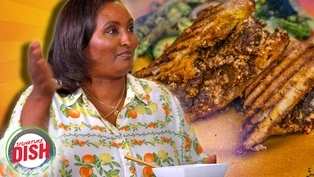
NewHow Lemon Slice Cafe Makes Its Incredible Awaze Tibs Panini
Video has Closed Captions
Clip: S4 Ep6 | 4m 38s | Seth visits Ethiopian-American Lemon Slice Cafe in Silver Spring for the Awaze Tibs Panini Sandwich. (4m 38s)
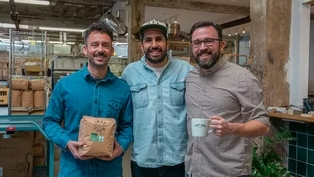
Preview: S4 Ep6 | 30s | Lost Sock in Takoma, Lemon Slice Cafe in Silver Spring, Rose Ave Bakery in Woodley Park. (30s)
 New
NewThe Secret Behind Rose Ave Bakery’s Famous Pandan Donut
Video has Closed Captions
Clip: S4 Ep6 | 5m 33s | Seth visits Rose Ave Bakery in Woodley Park to sample their signature pandan coconut donut. (5m 33s)
Providing Support for PBS.org
Learn Moreabout PBS online sponsorship
- Food
Christopher Kimball’s Milk Street Television
Transform home cooking with the editors of Christopher Kimball’s Milk Street Magazine.



Support for PBS provided by:
Signature Dish is a local public television program presented by WETA