
Mamdani on his bold agenda and working with Trump
Clip: 3/20/2026 | 11m 26sVideo has Closed Captions
Zohran Mamdani on his bold agenda, tackling Islamophobia and working with Trump
Zohran Mamdani is less than three months into his term as mayor of America’s largest city. He's juggling his ambitious campaign promises, a budget deficit and responding to a rise in Islamophobic rhetoric. He has also forged a unique working relationship with President Trump through Oval Office visits and a shared love of New York. Amna Nawaz sat down with Mamdani for an exclusive conversation.
Problems playing video? | Closed Captioning Feedback
Problems playing video? | Closed Captioning Feedback
Major corporate funding for the PBS News Hour is provided by BDO, BNSF, Consumer Cellular, American Cruise Lines, and Raymond James. Funding for the PBS NewsHour Weekend is provided by...
Support provided by:

Mamdani on his bold agenda and working with Trump
Clip: 3/20/2026 | 11m 26sVideo has Closed Captions
Zohran Mamdani is less than three months into his term as mayor of America’s largest city. He's juggling his ambitious campaign promises, a budget deficit and responding to a rise in Islamophobic rhetoric. He has also forged a unique working relationship with President Trump through Oval Office visits and a shared love of New York. Amna Nawaz sat down with Mamdani for an exclusive conversation.
Problems playing video? | Closed Captioning Feedback
How to Watch PBS News Hour
PBS News Hour is available to stream on pbs.org and the free PBS App, available on iPhone, Apple TV, Android TV, Android smartphones, Amazon Fire TV, Amazon Fire Tablet, Roku, Samsung Smart TV, and Vizio.
Providing Support for PBS.org
Learn Moreabout PBS online sponsorshipWILLIAM BRANGHAM: As the Muslim holy# month of Ramadan comes to a close,## Amna Nawaz traveled to New York# City to talk to one of the most## high-profile Muslim leaders in one of the most# high-pressure political jobs in the country.
Zohran Mamdani is less than three# months into his term as mayor of## America's biggest city.
He's juggling how# to fulfill his ambitious campaign promises,## manage a huge budget deficit, and respond to a# rise in Islamophobic rhetoric across the country.
The young Democratic socialist has also# forged a unique relationship with President## Trump through Oval Office visits and# their shared love of New York City.
Here's Amna's exclusive# conversation with Mayor Mamdani.
AMNA NAWAZ: Mr.
Mayor, welcome to the# "News Hour."
Thanks for making the time.
ZOHRAN MAMDANI (D), Mayor of New York City:# Absolutely.
Thank you so much for being here.
AMNA NAWAZ: So let's talk a little bit# about your first few months in offi.. You really had to hit the ground# running.
You had a lot coming at## you too.
You had a major nurses strike# to handle, a record-breaking snowstorm.
I know you have probably heard the# difference between campaigning in poetry,## governing in prose.
Does that bring true# to you?
Have you found that to be true?
ZOHRAN MAMDANI: I think there's still# a little poetry in the day-to-day.
AMNA NAWAZ: OK.
ZOHRAN MAMDANI: I think it's important that we don't let our imagination become# constrained by what .. And in some ways we tasked ourselves with# trying to keep up with New Yorkers, because,## in addition to first winter storm in# a while, first blizzard in 10 years,## nurses strike, where we stood there on the# picket line with the nurses as they fought## for wages that could afford to have to live in# New York City as they worked in New York City,## we also just wanted to show New Yorkers that# city government could work as fast as they do.
AMNA NAWAZ: What's surprised you most about# the role since you have stepped into it?
ZOHRAN MAMDANI: I think the amount that you can# do, to be honest with you.
It's not to say that## this work is easy, but that when you are willing,# there is an immense amount of possibility.
And then, on day eight, we joined together# with Governor Hochul to announce a $1.2## billion funding of a pathway to# universal childcare.
And that's## transformative for New York City families.# And to have the opportunity to be able to## act upon the vision that we'd shared with# New Yorkers, it's the gift of a lifetime.
AMNA NAWAZ: You also very early held a press# conference in which you shared that you would## inherited a major budget deficit, some $12# billion.
Tell me -- and you have repeated it## actually since then in multiple interviews# I know you want to get that message out.
Is that a little bit about# expectation setting?
Like,## you might not be able to hit all of the# affordability goals that you set out?
ZOHRAN MAMDANI: We just want to be honest# and transparent with New Yorkers.
We're## talking about a generational fiscal deficit,# as you said, inheriting what was $12 billion.
And thanks to the work that we have done in terms# of savings, in terms of utilizing our reserves,## we have brought that down to $5.4 billion, also# in partnership with the governor's commitment## to this city.
And now, over these next few weeks# and months, our job is to bring that down to zero.
AMNA NAWAZ: What's the plan to bring it# down to zero?
You have to raise revenue.
ZOHRAN MAMDANI: We believe that a structural# crisis deserves structural solutions.
And## that comes from taxing the wealthiest a# little bit more and also ensuring that## the relationship between the city and the state# isn't as imbalanced as it's been in the past.
AMNA NAWAZ: Following up on a campaign promise,## you said you were going to create a Department# of Community Safety with a billion-do.. What you announced this week, I think it's# fair to describe, is a pared-down version.
So is this part of this paring down of ambitions## because of the budget crisis?# How should we look at this?
ZOHRAN MAMDANI: Our ambitions# will never be pared down.
AMNA NAWAZ: OK.
ZOHRAN MAMDANI: This## is the beginning of wh.. However, New Yorkers can't afford to wait for# an answer to the mental health crisis.
They## can't afford to wait for a legislative process# to play out or for politics to come its course.## What this is all about is responding to the# crises, whether it's the mental health crisis,## the crisis of gun violence, the crisis of hate# violence, even gender-based violence in the city.
We are finally co-hearing what# were previously disparate offices,## putting them within one portfolio# of work within city government,## and starting to respond to them in a manner that# actually befits the seriousness of the issue.
AMNA NAWAZ: So, Mr.
Mayor, we# are speaking on the last day of## Ramadan.
And as the first Muslim mayor# of New York City, you, I understand,## have been fasting this entire time as you are# governing in this very demanding environment.
Just give me a sense of what# your days have been like.
ZOHRAN MAMDANI: Well, in many ways, the days# look as they did before.
There's obviously## an absence of food and water over the course# of them.
This may be the first time they're## seeing a Muslim in public office during the# month of Ramadan and all that comes with it.
For me, I am seeing so many Muslims who've# been here far longer than I have who've## been doing this work, and they have been# doing it no matter what the demand is.
AMNA NAWAZ: You also chose to break your fast one# day out on Rikers Island.
Tell me about that.
Why?
ZOHRAN MAMDANI: It was one of the most# meaningful evenings I have had as the mayor.
And to be on Rikers Island praying# alongside incarcerated New Yorkers,## as well as New Yorkers who work on Rikers# Island, it was really an occasion to## recognize the humanity in others and also, in# doing so, recognize more of it in ourselves.
AMNA NAWAZ: It's worth noting too, though,# in your first few months in office,## you have already seen anti-Muslim protesters# outside your home, not protesting your## policies or anything else, protesting your# faith outside of the place that you live.
You have been the target of attacks by lawmakers,## calling for you to be denaturalized and deported.# Representative Andy Ogles has said Muslims don't## belong in American society.
Representative# Randy Fine said we need more Islamophobia,## not less.
Representative Andrew Clyde# said no more Islamic immigration.
I think anyone who grew up post-9/11 knows that# anti-Muslim bigotry isn't anything new here, but,## to you, does it seem like there's something# different or something new this time?
ZOHRAN MAMDANI: I think there's# an unabashed nature to it,## and it is being echoed from the# highest offices in this country.
They do so without any sense of shame.
And what# is remarkable about Islamophobia and anti-Muslim## bigotry is not that it is bigoted, for there is# so much bigotry in this country.
It is that there## are very few who speak up in opposition to it,# the manner in which it has become normalized.## And it is not exclusive to any one political# party.
It is endemic, frankly, to our politics.
And what this kind of bigotry shows# is a complete erasure of the million## or so Muslims who call the city home, whose# identity has often been one that they are made## to feel as if is in tension with being in New# Yorker, when, as I grew up here, I understood,## and so many others did, that there is no tension# in those identities.
They can be one and the same.
AMNA NAWAZ: But, Mr.
Mayor,# when they're coming after you,## when they are showing your face on# TV screens, calling you a jihadist,## saying you're the enemy, do you worry# about your own safety and security here?
ZOHRAN MAMDANI: I'm very lucky that I have an# incredible team of NYPD officers who keep me safe## each and every day.
And my fear, frankly,# is for those whose names we do not know,## whose professions we do not know who# are seen and understood to be Muslim## and will be attacked for it.
And they# will not have the protections that I do.
AMNA NAWAZ: Among the millions# of people, of course, that you## represent here in New York is also the largest# Jewish population any city outside of Israel,## over a million people, many of whom,# as you know, did not vote for you.
Have you met with the groups that have expressed# concern about what they say was a rolling back## of protections against antisemitism?# What are those conversations like?
ZOHRAN MAMDANI: They have been continuing,# and it's really been a pleasure to meet with## so many Jewish leaders across the city.# It was actually not that long ago in this## very room that I met with a number# of Orthodox leaders across the city,## and we discussed antisemitism and our commitment# to rooting it out across the five boroughs.
We also discussed childcare and housing and# polity of life issues, because those are also## the concerns that fill the lives of Jewish New# Yorkers across the city.
My job is not to be a## mayor just for those who voted for me or those# who agree with my politics.
My job is to be the## mayor for everyone who calls the city home, and# to deliver them a city that they can be proud of.
AMNA NAWAZ: So, Mr.
Mayor, there was a time# not too long ago when the president himself## was attacking you quite frequently,# and you him, we should say.
He was## calling you a lunatic.
You had promised to# be his worst nightmare if you were elected.
After your meeting with him in# the Oval Office in November,## all of that changed.
Why?# What happened to that room?
ZOHRAN MAMDANI: You know, the president# and I have many disagreements.
We're not## shy about them.
We have been public about# them.
We have been private about them.
One thing we have very much in agreement is a# love of New York City.
And so in that meeting,## in the subsequent conversations, and then# in the following Oval Office meeting,## I have gone back to the president# with our hopes for what it could## look like to actually put this city on# better footing in the years to come.
I put forward a plan to build more housing than# New York City has seen in any single housing## development since the early '70s.
Alongside# that, I also made clear to the president,## as I have before, my continued belief# that ICE raids are cruel and inhumane,## that they do nothing to advance# the cause of public safety.
And I gave him and his chief of staff a list of# five who had been detained in or around Columbia## University.
And maybe about 30 or so minutes after# the meeting, the president called me to say that## he made the decision that he was going to release# that student who'd been detained that morning.
AMNA NAWAZ: So you found a way to have a# productive relationship with this president,## despite your many differences.# How would you describe that?
Is## it a partnership?
Is it an alliance?
What is it?
ZOHRAN MAMDANI: I think it's a productive# relationship between the mayor of this city,## the president of this country,# and one that is also honest.
I want to always be honest with the# president and with the public about## where those disagreements are and also that# my job is not to litigate the disagreements,## but to deliver for the people of New York City.
AMNA NAWAZ: How often do you# two text or talk to each other?
ZOHRAN MAMDANI: I will# leave that to the two of us,## but I will tell you that that's# the focus of that relationship.
AMNA NAWAZ: Once a week,# twice a week?
Hotter?
Colder?
ZOHRAN MAMDANI: I will keep# that between the two of us.
AMNA NAWAZ: I have to ask you about your# family before I let you go, because I think## anyone familiar with the specific and what I# would say very fortunate experience of being## raised by Desi parents, South Asian parents,# especially those with the courage and the hope## to forge an entirely new life in new nations,# you know that you can learn a lot from them.
ZOHRAN MAMDANI: Yes.
AMNA NAWAZ: What.. ZOHRAN MAMDANI: You know, my mother would always# tell me, if we don't tell our own stories,## no one else will.
And she imbued within me# the importance of being proud of who you are.
And my father, also, he taught me, so often# when you're growing up as a minority in a place,## you can grow up also with a sense# of almost a chip on your shoulder.## With it also comes the ability to see# the truth of a place in its entirety,## the promise of it and that which still needs# to be worked on.
And that was, in such a way,## so freeing to hear as a young person,# to understand my place in the world and## the responsibility that I had within it and# the fact that it was a gift, not a burden.
AMNA NAWAZ: Mr.
Mayor, it's been such# a pleasure to speak with you today.
Zohran Mamdani, the mayor of New York# City, thank you for making the time.
ZOHRAN MAMDANI: You're very# welcome.
Thank you so much.
 New
NewAs oil attacks continue, Trump says Iran is ‘finished'
Video has Closed Captions
As attacks on oil sites continue, Trump dismisses ceasefire, says Iran is ‘finished' (5m 57s)
 New
NewBrooks and Capehart on Trump struggling with fallout of war
Video has Closed Captions
Brooks and Capehart on Trump struggling to contain economic fallout of Iran war (10m 2s)
 New
NewDavid Hill joins Geoff Bennett on 'Settle In'
Video has Closed Captions
David Hill and Geoff Bennett discuss the business of sports betting on 'Settle In' (3m 7s)
 New
NewFrustrations grow at airports as DHS shutdown strains TSA
Video has Closed Captions
Long lines, frustrations grow at airports as DHS shutdown strains TSA staffing (5m 16s)
 New
NewNews Wrap: DHS funding deadlock shows no signs of ending
Video has Closed Captions
News Wrap: Deadlock over DHS funding shows no signs of ending (5m 41s)
 New
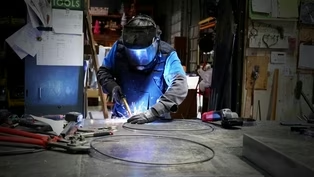
NewTrump promised a boom, but factory jobs continue to decline
Video has Closed Captions
Trump promised a manufacturing boom, but factory jobs continue to decline (9m 8s)
Providing Support for PBS.org
Learn Moreabout PBS online sponsorship
- News and Public Affairs

FRONTLINE is investigative journalism that questions, explains and changes our world.

- News and Public Affairs

Amanpour and Company features conversations with leaders and decision makers.












Support for PBS provided by:
Major corporate funding for the PBS News Hour is provided by BDO, BNSF, Consumer Cellular, American Cruise Lines, and Raymond James. Funding for the PBS NewsHour Weekend is provided by...