
Sweet Potato Vodka
5/4/2026 | 26m 30sVideo has Closed Captions
Sweet potatoes become popular vodka. “Sassy” cows help create special cheese and ice cream.
In California, sweet potatoes are the secret ingredient in award-winning vodka. Iowa is definitely where the tall corn grows, but these Iowa farmers are making a special kind of Hawkeye State wine. On Farm to Fork, we’ll learn how to make a sweet salad featuring candied oranges. In Wisconsin, some “sassy cows” create special kinds of cheese and ice cream.
Problems playing video? | Closed Captioning Feedback
Problems playing video? | Closed Captioning Feedback
America's Heartland is presented by your local public television station.
Funding for America’s Heartland is provided by US Soy, Sustainable Agriculture Research and Education, Rural Development Partners, and a Specialty Crop Grant from the California Department of Food and Agriculture.
Sweet Potato Vodka
5/4/2026 | 26m 30sVideo has Closed Captions
In California, sweet potatoes are the secret ingredient in award-winning vodka. Iowa is definitely where the tall corn grows, but these Iowa farmers are making a special kind of Hawkeye State wine. On Farm to Fork, we’ll learn how to make a sweet salad featuring candied oranges. In Wisconsin, some “sassy cows” create special kinds of cheese and ice cream.
Problems playing video? | Closed Captioning Feedback
How to Watch America's Heartland
America's Heartland is available to stream on pbs.org and the free PBS App, available on iPhone, Apple TV, Android TV, Android smartphones, Amazon Fire TV, Amazon Fire Tablet, Roku, Samsung Smart TV, LG TV, and Vizio.
Providing Support for PBS.org
Learn Moreabout PBS online sponsorship>> Hi I'm Jason Shoultz.
We're ready to share some unusual beverages in some unusual places on this edition of America's Heartland.
And we'll use one of your favorite fruits to create a one of a kind Farm to Fork recipe.
Do you serve sweet potatoes as part of your holiday meals?
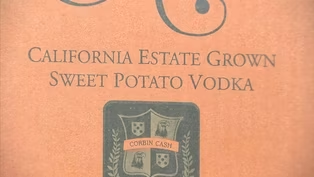
Well, one California farmer says that sweet potatoes are the secret ingredient in his award winning vodka.
We'll take you to Iowa.
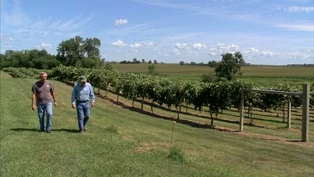
It may be where the tall corn grows, but it's also home to some folks making a special kind of wine in the Hawkeye State.
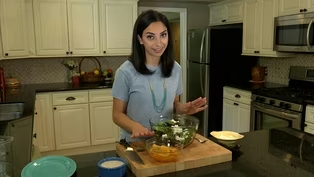
Sharon Profis is in the Farm to Fork kitchen with a recipe that's all about oranges.
Then, our Sarah Gardner is off to America's dairy land where some "Sassy Cows" create special kinds of cheese and ice cream.
It's all coming up on America's Heartland.
>> America's Heartland is made possible by: >> America never stops.
Neither do the farmers and ranchers who call her home.
And as rural America grows further, Farm Credit will be there, just as we have for 100 years.
>> CropLife America, representing the companies whose modern farming innovations help America's farmers provide nutritious food for communities around the globe.
>> The Fund for Agriculture Education.
A fund created by KVIE to support America's Heartland programming.
Contributors include the following: ♪ You can see it in the eyes ♪ ♪ of every woman and man.
♪ In America's Heartland, living close to the land.
♪ ♪ There's a love for the country ♪ ♪ and a pride in the brand.
♪ In America's Heartland, living close, ♪ ♪ close to the land.
♪♪ >> Hi there.
We're happy to have you along with us on America's Heartland.
Farmers and ranchers are very creative when it comes to finding new ways to utilize their land and, hopefully, increase their profits.
Many farmers diversify, they offer farm stay vacations, they may have seasonal corn mazes, or they plant crops that give them more than one harvest a year.
They're also willing to try something new.
And that was the case at the Souza farm in Central California where bright orange sweet potatoes were not heading for the supermarket, they were heading for the bottle.
♪♪ >> Some folks call them yams, others sweet potatoes.
Doesn't matter to David Souza.
He's selling them by the box full.
California's Central Valley is well known for crops that range from wheat and rye to almonds, citrus, grapes and cotton.
And Souza is the latest generation to turn this dusty Central California ground into a profitable farming operation.
>> I started working on the farm when I was 7 moving watermelons in the roadways.
That was my job until I was 10.
Then I started driving tractor in the watermelons.
Then I started, my dad kind of helped me get going on my own.
>> Today D and S farms grows almonds and sweet potatoes.
About 75 percent of the potatoes end up in grocery stores across the United States.
The rest are sold to be used as sweet potato seeds.
But a few years back David had another idea for these sweet spuds.
>> So yeah, you can see it's starting to boil there.
>> Oh look at that!
>> Turns out that sweet potatoes make pretty good liquor.
In a corner of the farm property is a distillery.
>> So basically I bought a book off the internet and I made a makeshift still in my garage and I did it for 3 years in my garage cooking it night after work, cooking sweet potatoes on my kitchen stove and it would take me 12 hours to distill a bottle on my, on my makeshift still, so I would sleep in my garage in a lawn-chair, because I didn't want to burn my garage down [laughs].
>> To understand where David got this unusual idea, you have to trace his life's journey.
♪♪ And the story of a farm boy turned Las Vegas promoter.
>> Well at that time I wanted to farm, um, didn't think I'd do anything else, I went to college for business, but kind of knew I was going to stay farming, and then when I hit my 20's, I kind of like, yeah, I might want to do something different, something was just totally opposite from farming, I always had an interest in music and listening to music and didn't have really any talent to play it, so I started doing concert promoting, car shows, and kind of that realm of the entertainment business is kind of what kind of led me to want to go to Las Vegas and look at different ah..., business aspects there.
>> As you might imagine, the idea of distilling liquor on the farm was not an immediate hit with everyone around these parts.
>> I think at first they thought is this thing going to make it?
Is it going to?
How is it going to work?
But now they're seeing the value.
>> But persistence paid off.
He convinced his family to take a chance.
Today you'll find his Sweet Potato spirits at liquor stores across the United States.
Named Corbin Cash, after his son.
>> There you go, a little sweet potato stew there, take a look at that.
>> So this is, they're chopped up, and then as they emulsify it'll turn into like a tomato bisque, it will be the consistency of the, of it when it's done, so right now these just got put in a little while ago as you can tell.
>> And these are crushed up, sliced up, sweet potatoes.
>> Yeah, they're pretty much diced up, they go in diced up and puréed, and then they, we break them down, and ah..., and they'll eventually look like a, like I said, tomato bisque soup.
>> It's amazing that it goes from this to vodka.
>> Vodka, correct.
>> Vodka is how he got his start.
His vodka has won prestigious national awards.
But in the liquor game, whiskey is where the money is at.
So David is most proud of his Corbin Cash Rye Whiskey.
He sells his brand as premium at a slightly higher price than average liquor.
And it's the only liquor on the market made from sweet potatoes.
>> The reason it's a premium product is the labor intensity behind it, so you know, by the time it starts in the field to the time it leaves the distillery um, you've got almost a year to 18 months involved and you've got over 50 people that have touched that bottle before it leaves the distillery.
>> David's timing is right.
Craft distilling is a growing trend across the country.
Can a California farm kid make it in the liquor game?
You might say David Souza is 100 percent proof.
♪♪ >> When it comes to agriculture, California is a major player in the nation's food game.
It's the country's number one dairy state.
Produces more wine than the other 49.
Contributes large quantities of fruits and vegetables.
And is the primary U.S.
source for almonds, walnuts, raisins, kiwi, dates and figs.
>> Everybody knows that Iowa is corn country.
In fact the Hawkeye state is the number one corn producing state in the nation.
But just like our California sweet potato grower, one Iowa farm family decided that their land might be used for something quite different.
>> The bottling crew is hard at work early this summer morning at Ardon Creek Vineyard and Winery.
This all volunteer crew is critical to the operation in more ways than one.
In fact this farm is as much about this gathering of friends as it is the wine grapes growing out back.
>> To understand the "vibe" of Ardon Creek you have to understand it's founders, Mike and Dianne Furlong.
They both grew up on farms but left for non-agriculture jobs, and now they're back on the family farmstead, not relaxing.
>> Well, I don't relax very well but uhm.., and the internet never works out here anyways.
>> After success in their chosen fields, just over 10 years ago they got interested in winemaking.
Not long after that, they decided to plant a few acres of grapes.
And the perfect place to do it was Mike's family farmstead that's been in his family since the 1800s.
>> The property we're on here, this 40 acres, was uh.. settled by the Furlongs in 1855 and they had migrated across New York and Ohio for about five years after the potato famine in Ireland.
And so, we have kind of an interesting endeavor in the middle of a corn/soybean state, but we think diversity is good and we hope other people do as well.
>> Mike's cousin Tom is what you might call a typical Iowa farmer.
He grows corn and soybeans and raises cattle just down the road.
>> Now, obviously this area is a, I would say a more traditional type of area.
Uh.. , were there any naysayers that said a winery in Letts, Iowa?
>> Well, I think there's, when anybody else starts a new business you always have those people that think uh.. , you've got your pretty crazy and so crazy idea and that it won't make it.
But, you know, I think also good that uh.., somebody is willing to take that and add a little diversity to the community.
So it was good to see that somebody was going to try something different.
>> But with risk, sometimes comes great reward.
And the Furlongs say their reward comes whenever a new customer stops by their wine shop to pick up a bottle.
>> It's pretty exciting.
The thing I like to ask them is where are you from and how did you find us or hear about us or have you tasted our wine?
>> They bottle both reds and whites, mostly sweeter wines, preferred in this region.
The Furlongs also make wine out of grape juice from New York's Finger Lakes region.
>> Do you have a favorite uh, varietal that they uh, serve up here?
>> Well, I like their uh, Commission Man Red, that's my favorite.
It's a little bit of a dry red, but uh, they're all uh, have their unique taste.
>> Meanwhile, those volunteers are hard at work inside.
>> How's it going?
>> Oh, it's going good today.
Started off a little slow.
We didn't have enough people, but it's going good now.
>> How many of these do you do in a minute?
You're kind of cranking them out.
>> Oh, I don't know by the minute.
We try to do 400 an hour, if things are, if things are going good.
So we'll divide that by what, 60, I guess.
>> And this is just, it just drops that cork right in there.
>> And that's it.
>> All right, here we go.
Tell me if I'm doing this right.
Check the wine level.
>> Yep, there ya go.
Check it and stick it in there.
Keep your fingers on it; your thumbs on it.
Oop, okay now let, now let it go.
There ya did it.
>> Look at that!
>> Yep, send it on.
>> Oh, I'm - I'm slowing them down.
I'm sorry.
>> Do - do another one.
>> Oh, I didn't check this one.
>> Eh, it's good.
>> Does that look all right?
>> Looks like there's a little extra in that one.
>> That's fine.
Extra's good.
Short's bad.
>> Lucky uh.. wine customer.
>> There ya go.
>> Yeah.
>> Look at that!
>> Yeah, nothing to it.
>> And Mike and Diane say they value this crew, and not just because it's free labor.
But they see it as something more, something that's been lost as Iowa farming has become more mechanized.
>> We both grew up on family farms with aunts and uncles and cousins all in a row and all together and everybody would come to vaccinate hogs, bale hay, whatever it was and that is gone in the farming community today.
>> And so, by doing the grapes what we've been able to do is have all kinds of people come and help plant the grapes, harvest the grapes and now bottle the juice so it's a way to get people together in agriculture.
>> And we will be introducing the Nuvaux... >> And while some people look for relaxation in retirement, the Furlongs insist this was never intended to be a hobby.
Proof?
They sell 27,000 bottles a year.
It's a business, with few days off.
>> We talked about a vacation in January; it ended up being one night [laughs] in another part of Northern Iowa.
>> Again, I'm a giver [laughs] >> There's a long history of winemaking in Iowa.
Western Iowa was home to commercial vineyards and wineries as far back as the 1850's.
As with many states, prohibition played a major role in curtailing Iowa wine production in the early 20th century.
And don't just think about grapes in the Iowa winemaking story.
Many vintners create distinctive wines from apples, berries and even honey, rhubarb and dandelions.
And, while we talk alcoholic beverages, since Iowa is the number one corn producing state in the nation, small scale mini distilleries have sprung up to transform Hawkeye corn into distilled spirits like bourbon.
♪♪ >> One of the things we like to do in our Farm to Fork segment is give you some ideas about new ways to serve old favorites.
Are you ready for something different in the citrus line?
Oranges are great for breakfast juice, after school treats or just peeling open to pop in your mouth.
And, of course, vitamin C packed in that orange package.
Well, our Sharon Profis is standing by with a recipe that serves up oranges in different way.
♪♪ >> There are so many ways to enjoy an orange that doesn't involve just eating it out of your hand, so today we're making a Fresh and Candied Orange Salad with a Lemon-Walnut Dressing.
Now before we get into this I want to share a little trick with you.
When I'm shopping for oranges I probably look a little crazy because here's the trick, what you want is to pick up the oranges and see if they're heavy.
Heaviest ones are the juiciest, they are the freshest, and if you pick one up that feels kind of light, skip it, you know that it's probably dry on the inside, so these are heavy, juicy oranges that are going to be great in this fresh salad.
The first way we're going to prepare the orange is by candying it, so for this we're using the entire orange; rind and flesh, and you want to slice it into pretty thin slices just like that.
♪♪ >> If you're stocking up on oranges you can leave them on the counter for 3 to 4 days, or you can keep them for longer in the fridge for up to 2 weeks.
♪♪ >> And we'll place these beautiful orange slices in a pot.
I know the rind is bitter but trust me once you candy them, it's going to be so good, and if you have any leftover, you can also use them as a garnish on a cake or other dessert.
So in with the oranges we'll add one cup of sugar, and one cup of water, let's take this to the stove and let it simmer until it becomes syrupy.
We've taken care of our candied oranges, now comes the fresh part.
We're going to segment these oranges so that you don't get any of the white pith, it's a really wonderful way to present oranges and you cut out all of the bitterness, so the first step is to cut off the tops and the skin just like that, I'm using a paring knife so that I have a little bit more control and you inevitably cut away some of the flesh, that's alright, just go all the way around the orange cutting away anything left behind as you go.
This is also a great way to cut oranges if you're making a fruit salad or you just want a really clean presentation.
Once you've cut away the skin it's time to remove the segments, and you want to use these white lines here as your guide and just cut along the edge of those lines until you get a segment, how nice is that?
It's a little bit more work, I know, but it's totally worth it because look how beautiful those segments are.
Now we're going to make that Lemon-Walnut Dressing, comes together quickly in a food processor, and in goes about a third of a cup of chopped walnuts, the juice of one lemon, some Dijon mustard, honey to counter-balance the acidity from the lemon, a pinch of salt, and we'll process this while I drizzle in half a cup of olive oil.
(food processor) ♪♪ >> That's the consistency we want, perfect, our candied oranges should be done so let's get them off the stove and finish our salad.
While the candied oranges are cooling we can assemble the rest of the ingredients, so I've already added red onion to the bowl of fresh oranges.
I'll also add some fresh avocado, I love the combination of avocado and oranges, creamy, citrusy and acidic, they complement each other very nicely, and by the way you can prepare all of these ingredients separately and just before you're ready to serve the salad you could put them together.
I have some fresh spring greens, you can also use spinach here for an even more nutritional twist, and goat cheese, this is crumbled goat cheese, also a wonderful compliment to the oranges and the avocado, I've done this with gorgonzola, blue cheese, and before we incorporate the candied oranges which are also a garnish we'll dress the salad, so we have our beautiful Lemon-Walnut Dressing.
Notice how creamy it is even though we didn't add anything like mayonnaise or cream to it, when you blend the walnuts they become creamy, so this is actually a very healthy salad if you don't count the sugar from the oranges.
This is going to be such a refreshing salad, especially since you have that fresh orange and then the surprise ingredient is definitely the candied orange.
What I like to do, is get a little fancy and take an orange, split it, and then just twist it, and repeat the same thing all the way around the salad.
Why don't we also add a little bit more goat cheese on top?
And there you have a beautiful candied and fresh orange salad that you can serve any time of year, and now all that's left to do is eat.
♪♪ >> Here's something you may not have known about oranges.
Christopher Columbus is thought to have brought the first orange seeds and seedlings to the New World on his second voyage in 1493.
And, Think about this when you next enjoy an orange.
There are typically ten segments inside an orange.
As for flavor, orange is said to be the world's favorite flavor, after chocolate and vanilla.
>> Consumers like you often look for different products at the supermarket than they might have searched out even a few years back.
Think about the changes.
Gluten free products, organic foods and an explosion in everything from yogurt to cheese in the dairy case.
Meeting that demand means that farmers and ranchers have to adjust production.
Well, our Sarah Gardner visited a dairy farm in Wisconsin where that "adjustment" affected entire herds of cows.
>> Whether at the grocery store or elsewhere, surveys show that consumers today want more choices in their food selection.
And farmers and ranchers are meeting the demand for more organic foods as well.
The U.S.
Department of Agriculture certified just 13,000 organic dairy cows in 1997.
By 2008 that number had grown to a quarter million animals.
Those statistics impact the kind of choices being made by farmers.
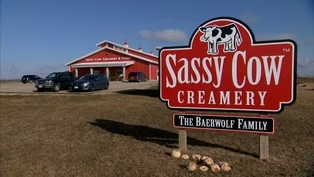
Numbers that played a role in production for Wisconsin's Sassy Cow Creamery.
Back in 2000, brothers James and Robert Baerwolf took their parents' dairy farm, split the herds in two, and began producing both organic and non-organic or traditional milk products.
>> At my farm we have 200 organic cows.
And at my brother Robert's farm we have 400 non-organic cows.
>> So, are all your products both organic and non-organic from the creamery?
>> Yes, We offer two separate lines.
Some of our customers choose to purchase organic milk at some of our stores as well.
And then some of our customers at store locations choose to purchase our non-organic milks.
>> With their dairy herd totaling several hundred cows on two separate farms, the Baerwolf brothers provide organically grown feed to that livestock segment and traditional feed to their other cows.
Between the two farms sits the production facility, a creamery built in 2008.
Here hundreds of pounds of cheese are processed.
Hundreds of quarts of ice cream are manufactured.
And more than 20,000 gallons of milk are bottled each and every week, organic and non-organic in separate production runs.
>> So, this is where the cheese curds operation happens.
>> Yep, this is our cheese vat.
We started at about six this morning.
>> How many gallons or ounces of... >> 3000 pounds of milk.
>> 3000 pounds of milk?
>> Yes.
>> So how many gallons of chocolate milk?
>> About 600 gallons.
>> 600 gallons, what once a week?
>> Yep, Thursday is our chocolate milk day.
>> The majority of the Sassy Cow dairy products will be delivered to grocery stores and supermarkets all across the state of Wisconsin.
But the Baerwolf brothers also saw a need to augment their dairy entrepreneurship with their own retail operation.
Serving both segments of the buying public, their farm store offers organic and traditional milk.
Oh, and did I mention they even have trading cards with pictures of the cows producing the milk?
>> And then there's the cheese making side of the business.
Tell me a little bit about that.
>> For us we do a small amount of cheese.
But, fresh cheese curds are popular, so we do about one vat per week.
>> The cheese curds are packed as a handy snack food, with some of the product finding its way into Wisconsin school rooms.
>> We 're also part of their school lunch snack program.
And so we provided some cheese curds for them to take to the schools especially in winter when there isn't fresh produce available for the program.
>> Sassy Cow also participates in the "Buy-Local, Buy-Fresh" program where Wisconsin growers promote sustainable farms by selling their products to local restaurants.
>> A lot of their restaurant members use a lot of our different products, our milk, our heavy cream.
And so we've made a lot of connections through their program with local chefs looking for local products.
>> As for the Sassy Cow Creamery, the Baerwolf brothers hope to eventually turn the company over to their kids, who they hope will become fourth generation Wisconsin dairy farmers.
>> Our parents had farmed, and our grandparents had farmed on the same location here.
So You know what it will be like for our kids only time will tell.
>> Have you visited our America's Heartland web site lately?
There is a lot there that we think you will like.
Just log on to AmericasHeartland.org.
We have video from all of our shows, recipes from Sharon Profis and plenty of information about American agriculture.
And don't forget you can connect with us on Facebook or check out our America's Heartland videos on YouTube.
That's going to do it for this time.
Thanks for traveling the country with us on this edition America's Heartland.
♪ You can see it in the eyes ♪ ♪ of every woman and man.
♪ ♪ In America's Heartland, living close to the land.
♪ ♪ There's a love for the country and ♪ ♪ a pride in the brand.
♪ In America's Heartland, living close, ♪ ♪ close to the land.
>> America's Heartland is made possible by: >> America never stops.
Neither do the farmers and ranchers who call her home.
And as rural America grows further, Farm Credit will be there, just as we have for 100 years.
>> CropLife America, representing the companies whose modern farming innovations help America's farmers provide nutritious food for communities around the globe.
>> The Fund for Agriculture Education.
A fund created by KVIE to support America's Heartland programming.
Contributors include the following:
 New
NewVideo has Closed Captions
In California, sweet potatoes are the secret ingredient in award-winning vodka. (5m 22s)
 New
NewFarm to Fork: Candied Orange Salad
Video has Closed Captions
On Farm to Fork, we’ll learn how to make a sweet salad featuring candied oranges. (6m 43s)
 New
NewIowa Farmer Turns Cornfields into Vineyards
Video has Closed Captions
Iowa is definitely where the corn grows, but these Iowa farmers are making Hawkeye State wine. (5m 50s)
 New
NewVideo has Closed Captions
In Wisconsin, some “sassy cows” create special kinds of cheese and ice cream. (4m 33s)
Providing Support for PBS.org
Learn Moreabout PBS online sponsorship
- Food
Christopher Kimball’s Milk Street Television
Transform home cooking with the editors of Christopher Kimball’s Milk Street Magazine.


Support for PBS provided by:
America's Heartland is presented by your local public television station.
Funding for America’s Heartland is provided by US Soy, Sustainable Agriculture Research and Education, Rural Development Partners, and a Specialty Crop Grant from the California Department of Food and Agriculture.